Beweisarchiv: Gewöhnliche Differentialgleichungen
Eindeutigkeitstheorie: Lokale Lipschitz-Stetigkeit Existenztheorie: Existenz nicht-fortsetzbarer Lösungen · Satz von Picard-Lindelöf Lineare Theorie: Liouville'sche Formel
Sei
J
⊂
R
{\displaystyle J\subset \mathbb {R} }
A
:
J
→
R
n
×
n
{\displaystyle A:J\rightarrow \mathbb {R} ^{n\times n}}
Φ
{\displaystyle \ \Phi }
Matrixlösung
von
y
′
(
x
)
=
A
(
x
)
y
(
x
)
,
{\displaystyle \ y'(x)=A(x)y(x)\ ,}
d. h.,
Φ
:
J
→
R
n
×
n
{\displaystyle \Phi :J\rightarrow \mathbb {R} ^{n\times n}}
Φ
′
(
x
)
=
A
(
x
)
Φ
(
x
)
{\displaystyle \ \Phi '(x)=A(x)\Phi (x)}
x
,
x
0
∈
J
{\displaystyle x,x_{0}\in J}
det
Φ
(
x
)
=
det
Φ
(
x
0
)
⋅
exp
(
∫
x
0
x
S
p
u
r
(
A
(
ξ
)
)
d
ξ
)
.
{\displaystyle \det \Phi (x)=\det \Phi (x_{0})\cdot \exp \left(\int _{x_{0}}^{x}{\rm {Spur}}(A(\xi )){\rm {d}}\xi \right)\ .}
Seien
x
∈
J
{\displaystyle x\in J}
h
∈
R
∖
{
0
}
{\displaystyle h\in \mathbb {R} \setminus \{0\}}
x
+
h
∈
J
{\displaystyle x+h\in J}
r
(
h
)
:=
Φ
(
x
+
h
)
−
Φ
(
x
)
−
h
Φ
′
(
x
)
{\displaystyle \ r(h):=\Phi (x+h)-\Phi (x)-h\Phi '(x)}
gilt
r
(
h
)
h
→
0
{\displaystyle {\frac {r(h)}{h}}\rightarrow 0}
h
→
0
{\displaystyle h\rightarrow 0}
Φ
′
(
x
)
=
A
(
x
)
Φ
(
x
)
{\displaystyle \ \Phi '(x)=A(x)\Phi (x)}
det
(
Φ
(
x
+
h
)
)
=
det
[
(
I
+
h
A
(
x
)
)
⋅
Φ
(
x
)
+
r
(
h
)
]
.
{\displaystyle \det(\Phi (x+h))=\det[(I+hA(x))\cdot \Phi (x)+r(h)]\ .}
Als erstes zeigt man, dass
die Störung
r
(
h
)
{\displaystyle r(h)}
S
n
{\displaystyle S_{n}}
symmetrische Gruppe der Ordnung
n
{\displaystyle n}
B
(
h
)
:=
(
I
+
h
A
(
x
)
)
⋅
Φ
(
x
)
.
{\displaystyle B(h):=(I+hA(x))\cdot \Phi (x)\ .}
Nach der Leibniz-Formel für die Determinante gilt
det
(
B
(
h
)
+
r
(
h
)
)
=
∑
σ
∈
S
n
sgn
(
σ
)
∏
i
=
1
n
[
B
(
h
)
+
r
(
h
)
]
i
,
σ
(
i
)
=
∑
σ
∈
S
n
sgn
(
σ
)
(
∏
i
=
1
n
[
B
(
h
)
]
i
,
σ
(
i
)
+
R
(
h
,
σ
)
)
=
det
(
B
(
h
)
)
+
∑
σ
∈
S
n
sgn
(
σ
)
R
(
h
,
σ
)
{\displaystyle {\begin{aligned}\det(B(h)+r(h))\;&=\sum _{\sigma \in S_{n}}{\textrm {sgn}}(\sigma )\prod _{i=1}^{n}[B(h)+r(h)]_{i,\sigma (i)}\\\\&=\sum _{\sigma \in S_{n}}{\textrm {sgn}}(\sigma )(\prod _{i=1}^{n}[B(h)]_{i,\sigma (i)}+R(h,\sigma ))\\\\&=\det(B(h))+\sum _{\sigma \in S_{n}}{\textrm {sgn}}(\sigma )R(h,\sigma )\\\end{aligned}}}
mit
R
(
h
,
σ
)
:=
∏
i
=
1
n
[
B
(
h
)
+
r
(
h
)
]
i
,
σ
(
i
)
−
∏
i
=
1
n
[
B
(
h
)
]
i
,
σ
(
i
)
.
{\displaystyle R(h,\sigma ):=\prod _{i=1}^{n}[B(h)+r(h)]_{i,\sigma (i)}-\prod _{i=1}^{n}[B(h)]_{i,\sigma (i)}\ .}
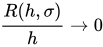
Aus
r
(
h
)
h
→
0
{\displaystyle {\frac {r(h)}{h}}\rightarrow 0}
h
→
0
{\displaystyle h\rightarrow 0}
R
(
h
,
σ
)
h
→
0
{\displaystyle {\frac {R(h,\sigma )}{h}}\rightarrow 0}
σ
∈
S
n
{\displaystyle \sigma \in S_{n}}
det
(
(
I
+
h
A
(
x
)
)
Φ
(
x
)
+
r
(
h
)
)
=
det
(
I
+
h
A
(
x
)
)
det
(
Φ
(
x
)
)
+
o
(
h
)
.
{\displaystyle \det((I+hA(x))\Phi (x)+r(h))=\det(I+hA(x))\det(\Phi (x))+o(h)\ .}
Seien
λ
1
,
…
,
λ
n
{\displaystyle \lambda _{1},\ldots ,\lambda _{n}}
Eigenwerte von
A
(
x
)
{\displaystyle A(x)}
x
{\displaystyle x}
Spur einer Matrix die Summe ihrer Eigenwerte ist,
folgt
det
(
I
+
h
A
(
x
)
)
=
∏
j
=
1
n
(
1
+
h
λ
j
)
=
1
+
h
∑
j
=
1
n
λ
j
+
o
(
h
)
=
1
+
h
⋅
Spur
(
A
(
x
)
)
+
o
(
h
)
.
{\displaystyle \det(I+hA(x))=\prod _{j=1}^{n}(1+h\lambda _{j})=1+h\sum _{j=1}^{n}\lambda _{j}+o(h)=1+h\cdot {\textrm {Spur}}(A(x))+o(h)\ .}
Dies impliziert
(
det
Φ
)
′
(
x
)
=
S
p
u
r
(
A
(
x
)
)
⋅
det
Φ
(
x
)
{\displaystyle (\det \Phi )'(x)={\rm {Spur}}(A(x))\cdot \det \Phi (x)}
x
∈
J
{\displaystyle x\in J}
Für
F
(
x
)
:=
exp
(
−
∫
x
0
x
S
p
u
r
(
A
(
ξ
)
)
d
ξ
)
⋅
det
Φ
(
x
)
{\displaystyle F(x):=\exp \left(-\int _{x_{0}}^{x}{\rm {Spur}}(A(\xi )){\rm {d}}\xi \right)\cdot \det \Phi (x)}
gilt
F
′
(
x
)
=
−
S
p
u
r
(
A
(
x
)
)
F
(
x
)
+
S
p
u
r
(
A
(
x
)
)
F
(
x
)
=
0
,
{\displaystyle \ F'(x)=-{\rm {Spur}}(A(x))F(x)+{\rm {Spur}}(A(x))F(x)=0\ ,}
also
det
Φ
(
x
)
=
F
(
x
0
)
exp
(
∫
x
0
x
S
p
u
r
(
A
(
ξ
)
)
d
ξ
)
=
det
Φ
(
x
0
)
exp
(
∫
x
0
x
S
p
u
r
(
A
(
ξ
)
)
d
ξ
)
{\displaystyle \det \Phi (x)=F(x_{0})\exp \left(\int _{x_{0}}^{x}{\rm {Spur}}(A(\xi )){\rm {d}}\xi \right)=\det \Phi (x_{0})\exp \left(\int _{x_{0}}^{x}{\rm {Spur}}(A(\xi )){\rm {d}}\xi \right)}
x
∈
J
.
{\displaystyle x\in J\ .}
◻
{\displaystyle \Box }
Carmen Chicone: Ordinary Differential Equations with Applications , 2. Auflage. Texts in Applied Mathematics 34, Springer-Verlag, 2006, ISBN 0-387-30769-9 













![{\displaystyle \det(\Phi (x+h))=\det[(I+hA(x))\cdot \Phi (x)+r(h)]\ .}](https://wikimedia.org/api/rest_v1/media/math/render/svg/459219c7aa9c521090309586ea333ecd22db6a0a)



![{\displaystyle {\begin{aligned}\det(B(h)+r(h))\;&=\sum _{\sigma \in S_{n}}{\textrm {sgn}}(\sigma )\prod _{i=1}^{n}[B(h)+r(h)]_{i,\sigma (i)}\\\\&=\sum _{\sigma \in S_{n}}{\textrm {sgn}}(\sigma )(\prod _{i=1}^{n}[B(h)]_{i,\sigma (i)}+R(h,\sigma ))\\\\&=\det(B(h))+\sum _{\sigma \in S_{n}}{\textrm {sgn}}(\sigma )R(h,\sigma )\\\end{aligned}}}](https://wikimedia.org/api/rest_v1/media/math/render/svg/c6bc327350e7362c6d1370f7cc6e431c09000d16)
![{\displaystyle R(h,\sigma ):=\prod _{i=1}^{n}[B(h)+r(h)]_{i,\sigma (i)}-\prod _{i=1}^{n}[B(h)]_{i,\sigma (i)}\ .}](https://wikimedia.org/api/rest_v1/media/math/render/svg/454383faf9f55a8dc04bf34d03a1dcc7d586c8ce)