


Physikalische Grundlagen der Nuklearmedizin/ Dynamische Studien in Nuklearmedizin
Einleitung[Bearbeiten]
Die ist das 13te Kapitel des Wikibooks Physikalische Grundlagen der Nuklearmedizin
Der Stoffwechsel einer Substanz im menschlichen Körper ist das Ergebnis verwobener dynamischer Prozesse welche die Absorption, Verteilung, Verwendung, den Abbau bis hin zur Ausscheidung der Substanz umfassen. Die Messung nur eines dieser Parameter kann zu Ergebnissen führen die eine Erkrankung anzeigen, jedoch nicht ihre genaue Ursache. Detailliertere Information über die Ursachen kann aus der Kenntnis des gesamten Stoffwechselsystems erhalten werden. Eine Methode besteht in der rechnerischen Simulation des Physiologischen Systems. Die Ergebnisse dieser Ansätze schließen die Erzeugung einer Darstellung des gesamten Systems sowie ein Verständnis der Interaktionen zwischen seinen Komponenten ein. Dieser Weg besteht üblicherweise in folgenden Schritten.
- Beschaffung experimenteller Messdaten, über das zu simulierte System, durch Verwendung von mit entsprechenden Tracern markierten Substanzen.
- Vergleich der experimentellen Ergebnisse mit den aus der Simulation erhaltenen Daten
- Ändern der Parameter der Simulation bis diese beiden Datensätze so gut wie möglich übereinstimmen, wobei Verfahren wie die Methode der kleinsten Quadrate, Maximum-Likelihood-Methoden
und ]Monte-Carlo-Simulationen eingesetzt werden.
Die allgemeinen Annahmen für diesen Ansatz sind:
- Die Hinzufügung des Tracers verändert das Verhalten des Systems nicht
- Die zu untersuchende Substanz ist während des gesamten Prozesses erhalten
- Der Tracer ist während des Prozesses, bis auf seinen Radioaktiven Zerfall, erhalten
- Das System ist im stationären Gleichgewicht.
Es gibt zwei wesentliche Modelarten:
- Deterministisch wobei analytische Ausdrücke verwendet werden um das exakte Zeitverhalten eines Tracers in jedem Teil des Systems zu beschreiben. Die mathematischen Ausdrücke sind meist Exponentialfunktionen.
- Stochastisch wobei das Verhalten des Systems durch Zufallsprozesse bestimmt wird, die durch Wahrscheinlichkeitsfunktionen beschrieben werden.
Wir werden uns weiter unten mit deterministischen Modellen im Detail beschäftigen.
Für jedes Modell ist eine einfache kleine Zeichnung angegeben, die das Modell vollständig beschreibt und die intuitiv leicht zu erfassen ist. Man kann jedoch aus dieser Zeichnung die zeitlichen Verläufe der Tracerkonzentrationen berechnen. Die sich ergebenden Formeln wirken auf Mediziner gemeinhin furchterregend. Alle Formeln sind jedoch als Graphen darstellt so dass man auch sie intuitiv erfassen und zusammen mit den Zeichnungen ein Gefühl für das Verhalten des Systems entwickeln kann. Es ist klar das die Formeln notwendig sind um die Graphen zeichnen zu können. Die Formeln sind ohne Herleitung angegeben. Offenbar muss man sie herleiten um sie in diesem Buch aufschreiben zu können und die Herleitung ist auch für einen Menschen mit entsprechender Erfahrung leicht möglich und sogar recht lustvoll, vor allem wenn man langweilige Teile durch frei zugängliche automatisierte Algebrasysteme erledigen lassen kann. Dennoch wollen wir in diesem Kapitel auf die Herleitung der Formeln verzichten um den Leser nicht übermäßig zu quälen[1]. Entsprechend veranlagte Scheinminderjährige können die Details im mathematatischen Anhang nachlesen um sich Befriedigung zu verschaffen. Eine wichtige Grundlage der Modelle ist das Fick'sche Gesetz. Es lautet (in einer für unsere Zwecke vereinfachten Form):

Der Tracerfluss von Abteilung in die Abteilung ist Proportional der Differenz zwischen Tracerkonzentrationen ( und ) in den Abteilungen und . Die Propotionalitätskinstente haben wir mit bezeichnet. Durch die Vorzeichen ist klar, dass ein Fluss von nach auftritt, wenn die Konzentration in höher ist als in .


Wir betrachten Gleichungen der Form:
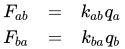
Dabei bezeichnet und die Tracemengen in den Abteilungen und . Die Verwandtschaft zum Fickschen Gesetz ist deutlich zu erkennen. Jedoch erlaubt unsere Formulierung auch Übergänge bei denen der Teilchentransport in einer Richtung effektiver möglich ist als in der anderen. Diese Vorgänge bezeichnet man als Osmose.


- ↑ vergleiche auch J.J. Sakurai, Modern Quantum Mechanics: "You have to be either a fool or a masochist to use the Lz,Sz eigenkets as base kets for this problem.". Frage des Übersetzers: Reicht es eigentlich auch Jongleuer zu sein und Aikido zu üben?
Abteilungsanalyse[Bearbeiten]
Diese Art der deterministischen Analyse versucht das Stoffwechselsystem in eine Anzahl miteinander verbundener Ableitungen zu unterteilen. Wobei eine Abteilung als anatomische, physiologische, chemische oder physikalische Unterteilung der Systems verstanden werden kann. Man nimmt vereinfachend an, dass der traces innerhalb eines jeden Abteils gleichmäßig verteilt ist. Das einfachstes System ist das Einabteilungsmodell. Wir beginnen unsere Behandlung des Themas mit diesem einfachen Modell und denen es später auf Komplexere Modelle aus und arbeiten uns dann zu den komplexeren vor. Die ersten Modelle brachen wir im wesentliche um das Handwerkszeug zu erlernen, die späteren jedoch sind unmittelbar für die Nuklearmedizin relevant für dynamische Studien in der Nuklearmedizin, die Messdatenerfassung und Analyse.
Man beachte das eine Tabelle heruntergeladen werden kann, mit deren Hilfe man mit den einzelnen Modellen interaktiv spielen kann.
Einabteilungsmodell[Bearbeiten]
In der folgenden Abbildung ist der Fluss eines Tracers durch die Blutgefäße nach einer idealen Bolusinjektion beispielhaft gezeigt. Die Abteilung ist geschlossen bis auf den Einfluss und Ausfluss der zu untersuchenden Substanz (hier Blut) und der Tracer wird in die Abteilung injiziert. In unserer Theorie nehmen wir an, dass sich der Tracer sofort gleichmäßig in der Abteilung verteilt, sobald er injiziert wird. Seine Menge in der Abteilung wird mit der Zeit abnehmen, abhängig von der Rate des Ausflusses. Die in der Abbildung benutzten Variablen sind:
der Ausfluss F

Wir können die relative Abnahme k als Verhältnis dieser beiden Größen definieren und erhalten somit:

dies können wir umschreiben zu:

Ohne auf die mathematischen Details einzugehen, (die denen bei der Ableitung des Gesetzes der radioaktiven Zerfall sehr ähnlich sind) lautet die Lösung dieser Gleichung:

wobei die Menge des Tracers bezeichnet, die zum Zeitpunkt, = 0 vorhanden ist.


Die Gleichung ist unten aufgetragen, um den Einfluss der relativen Abnahme k darzustellen:

Der Graph zeigt, dass die Menge des Tracers in der Abteilung nach der Injektion exponentiell mit der Zeit abnimmt, wobei die Abnahmerate vom Ausfluss abhängig ist, wie man intuitiv erwarten kann.
Zwei Abteilungs Modell -(geschlossenes System)[Bearbeiten]
Ein etwas aufwendigere, doch immer noch recht einfache, Klasse von Modellen sind diejenigen die auf zwei Abteilungen aufbauen. In einem geschlossenen System bewegt sich der Tracer zwischen zwei Systemen ohne das insgesamt eine Zu- oder Abnahme der Menge des Tracers auftritt. Dies ist in der folgenden Abbildung dargestellt.

Hieraus ergeben sich sofort zwei das System beschreibende Gleichungen,
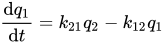
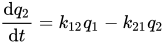
Da die Gesamtmenge des Tracers erhalten ist gilt ferner,

und somit,
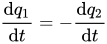
Wobei das Vorzeichen andeutet, dass eine Abnahme des Tracers in Abteilung #1 eine Zunahme in Abteilung #2 und umgekehrt bedeutet. Man betrachte nun die Situation wie sie in der obigen Abbildung gezeigt ist, wobei der Tracer zum Zeitpunkt t = 0 injeziert wird. Zu diesem Zeitpunkt gilt daher:

zum Anfangszeitpunkt gilt ferner:
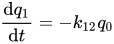
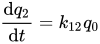
Die Lösungen dieser Gleichungen sind:

und

Das Verhalten dieser Funktionen ist unten für einen Spezialfall mit k12 = k21 und gleichem Volumen beider Abteilungen dargestellt

Man beachte, dass dieses Modell vorhersagt das ein stationärer Zustand erreicht wird indem die Tracemenge in Abteilung 1 exponentiell abnimmt, die Tracermenge in Abteilung 2 hingegen exponentiell zunimmt, wobei die Geschwindigkeit der Zustandsänderung durch die Summe der Austauschraten bestimmt wird.
Zweiabteilungsmodell - offenes verkettetes System[Bearbeiten]
Dies ist eine Erweiterung des eine Erweiterung des oben betrachteten Zweiabteilungsmodells in der eine Reihenschaltung zweier Abteilungen betrachtet wird. Dies ist in der folgenden Abbildung gezeigt.

Bei diesem Modell gilt:

Die Lösungen dieses Gleichungssystems sind:
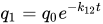
und

Die folgende Abbildung zeigt das Verhalten von und für den Spezialfall das dreimal so groß ist wie .


Man erkennt die Ähnlichkeit zwischen dem Verhalten von in diesem Graphen und dem arteriellen Tracerfluss nach einer intravenösen Injektion, sowie der kumulierten Aktivität in der Dosimetrie.
Zweiabteilungsmodell - offenes mamillares System[Bearbeiten]
Dieses Modell ist äquivalent zu dem oben betrachteten Zweiabteilungsmodell, wobei ein zusätzlicher Abfluß aus einer Abteilung vorhanden ist:

In diesem Falle gilt,

Bei :

und am Anfang

Die Lösungen dieser Gleichungen sind:

und

wobei

Die folgende Abbildung zeigt das Verhalten von 1 und 2.


Dieses Model wurde in weiten Bereichen verwendet, insbesondere für folgende Studien:
- Den Metabolismus[1] der Proteine des Plasmas, dabei ist Abteilung 1 das Plasma und Abteilung 2 der extravaskuläre Raum.
- Ansammlung von Pertechnetrat in der Schilddrüse
- Abteilung 1: das Plasma
- Abteilung 2: die Schilddrüse
- Clearance rate vom Plasma in die Schilddrüse
- Leckrückfluss aus der Schilddrüse in das Plasma

- ↑ Stoffwechsel
Modelle mit drei Abteilungen[Bearbeiten]
Das offene malillare Model wie wir es oben diskutiert haben wurde, um auch Iodid Uptake betrachten zu können, um eine dritte Abteilung erweitert, welche durch einen irreversiblen Fluss aus Abteilung 2 befüllt wird.


wobei:
- Abteilung #1: das Plasma
- Abteilung #2: das Ansammeln von inorgnischem Iodid in der Schilddrüse und
- Abteilung #3: Iodid innerhalb der Schilddrüse welches als Teil des Hormonsynthese Prozesses organisch gebunden wurde.
Das offene Maillare System wurde auch auf renale Clerance angewandt, wobei
das System aus einer interavaluklären Abteilung und einer sich damit
im Austausch befindlichen extravaskulären Abteilung besteht welches
irreversiebel mit der Urinabteilung verbunden ist.

Die Intravaskuläre Abteilung (#1) in der obigen Abbildung stellt den Tracer dar welcher mit den Renalen Parenchym und dem Extravaskulären Raum ausgetauscht werden kann. Die Uring Abteilung (#2) stellt den Tracer dar, welcher durch die Nieren ausgewaschen wurde und bezieht sich somit entsprechend auf der Nierenbecken und die Blase. Die Extravaskuläre Abteilung (#3) stellt den Tracer dar, welcher nicht die Nieren ausgewachsen wurde, z.B. Tracer der an Moleküle im Gewebe außerhalb der Niere gebunden wurde.
Wird der Tracer über die periphere Vene in die intravaskuläre Abteilung injiziert, so wird die Tracerverteilung über den Körper zunächst nicht gleichförmig sein. Diese Konzentrationsschwankungen werden jedoch durch die Zirkulation des Blutes bald ausgeglichen. Für eine stark vaskuläre Region, wird eine Graphik der Tracermege gegenüber der Zeit einen anfänglichen starken Anstieg mit recht zügigem Abfall aufweisen. Die Ausprägung diese Masximums wird abhängen von:
- der anatomischen Region
- dem Ort der Injektion
- der Injektionsgeschindigkeit.
Die Abteilungsanalyse kann daher nicht auf diesen Teil des Renogramms angewandt werden, da die grundlegende Annahme einer Gleichförmigen Tracerverteilung hier nicht erfüllt ist.
Nach dieser Phase beginnen die Tracermengen in den Intravaskulären Abteilungen abzunehmen weil:
- es zur Aufnahme (Uptake) des Tracers durch die Nieren kommt wie durch k12 in der obigen Abbildung beschrieben.
- Diffusion in das extravaskuläre Gebiet wie in der Grafik oben durch k13 dargestellt.
Sobald sich die Tracermenge im extravaskulären Gebiet aufzubauen beginnt, entsteht ein Austausch in umgekehrter Richtung, also vom extravaskulären in den intravaskulären Bereich wie er in der obigen Abbildung durch k31 dargestellt ist, so dass ein Maximum der Tracermenge erreicht wird ehe sie wieder abnimmt. Dies ist unten graphisch für die unten angegebene Situation dargestellt.
| k12 = 0.05 pro minute | k13 = 0.04 per minute | k31 = 0.06 pro minute |
| l1 = 0.13 pro minute | l2 = 0.024 pro minute |
| A1 = 0.65 | A2 = 0.35 |

Schlussendlich wird sich der Gesamte Tracer im Urin ansammeln
Die für die obige Graphik verwendeten Gleichungen sind:
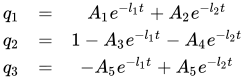
wobei und Konstanten sind die von den Übergrangsraten zwischen den Abteilungen abhängen. Für die verbleibenden Konstanten gilt bis .



In der Praxis, wird die Renale Clearance bestimmt indem die Tracermenge in der Intravaskulären Abteilung (also die Konzentration im Blutplasma ) untersucht wird, wobei:


Die Zeitabhängkeit dieser Konzentration wird sich in der gleichen Weise verlaufen wie , so dass:

wobei sich und auf und beziehen. Die Renale Clearance, welche sich auf bezieht kann daher bestimmt werden indem der biexponentielle Abfall in der Intravaskulären Abteilung untersucht wird.


Glomerulare Filtrations Rate[Bearbeiten]
Die Glomerulare Filtrations Rate (GFR) gilt im Allgemeinen als die wichtigste einzelne Kennzahl der Nierenfunktion. Sie ist besonders bedeutsam für die Feststellung der schwere einer Nierenschädigung und kann somit anzeigen, ob eine Dialyse Therapie in Betracht gezogen werden sollte.
Es gibt drei wesentliche Methoden um die GFR eines Patienten zu bestimmen
- Inulin clearance,
- Creatinine clearance,
- Radiotracer clearance.
Inulin clearance has been used for many years and is often regarded as the most reliable and accurate of the three methods. Its major disadvantages however include the need for continuous intravenous infusion, timed urine collections via a bladder catheter and protracted chemical analysis, in addition to the disturbing and potentially hazardous impact on the patient. Creatinine clearance has been widely used for routine GFR assessment, as a result. However, while the latter method gives similar results as the former under normal conditions, the validity of its results is questionable in patients who have moderate to advanced renal failure because of an increasing significance of tubular secretion.
The third method, radiotracer clearance has been widely adopted using 51Cr-EDTA. This tracer is known to be physiologically inert, not bound to plasma proteins and not metabolized by erythrocytes or organs other than the kidneys. It is normally excreted within 24 hours of injection, 98% via the kidneys. 51Cr has a half-life of 28 days and decays by 100% electron capture into stable vanadium, emitting monoenergetic (320 keV) gamma-rays in about 10% of the transformations. In addition, 51Cr-EDTA determination of GFR can be used in conjuction with 123I-PAH renal plasma flow assessment for the differential diagnosis of various renal conditions.
The typical radioactivity administered for 51Cr-EDTA clearance is 1-10 MBq and the radiopharmaceutical is generally administered via intravenous injection. This Single Shot technique assesses the GFR through venous blood sampling, in the simplest case, or by continuous external monitoring of the gamma-rays from 51Cr in the more sophisticated approach. When the patient counts are plotted against time on a log/linear axis, a curve is generated which falls off rapidly at first and thereafter decreases at a constant rate, representing the behavious of q1 is our last figure. This initial fall-off arises as a result of the establishment of an equilibrium between the radiotracer and the extravascular, extracellular fluids. The slower second phase reflects renal excretion and contains the information necessary for GFR assessment.

A quick and simple technique is to obtain two blood samples from the patient, one at two hours and the other at four hours post injection. The counts in the plasma of each sample are determined using a scintillation counter and compared with the counts from a standard solution. The standard solution is made by diluting an injection, identical to the patient's, in a known volume of water, e.g. 1 liter.
The slope, m, of the second portion of the above curve can be determined from:
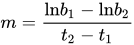
where:
- : time from injection for the first blood sample, usually 120 minutes,
- : counts in the plasma from the first sample (corrected for background counts),
- : time from injection for the second blood sample, usually 240 minutes,
- : counts in the plasma from the second sample (also corrected for background).


We can now extrapolate this straight line back to the time of injection, , to determine the what the plasma counts would be upon instantaneous mixing of the tracer throughout the patient's plasma compartment, i.e.


wie in der folgenden Abbildung gezeigt:

und

The Dilution Principle can now be used to determine the volume of this plasma compartment by comparing the plasma counts with those from the standard solution, i.e.

which results in

when the standard injection is diluted in 1 liter. The clearance is then given by the following equation:

Results for two patients are shown below to illustrate this technique.
Patient A
| Sample | |
|---|---|
| Background | |
| at 119 mins | |
| at 238 mins | |
| Standard |
This patient's 51Cr-EDTA clearance was determined to be 38.8 ml/min, which equals 25.9 ml/m2/min when corrected for the area of their body surface - for standarization purposes. This result was assessed to be indicative of chronic renal failure, which was later found to be due to lupus nephritis. The patient was then placed on steroid therapy.
Two months later the patient was re-tested and the clearance was found to have risen to 35.2 ml/m2/min. For the patient's age, this clearance was gauged as within the normal range indicating that the therapy was having a positive effect. The therapy was then ceased. Two months further, the patient was again tested haaving been without steroid therapy for this period. The result was 36.2 ml/m2/min indicating successful treatment.
Patient B
| Sample | |
|---|---|
| Background | |
| at 122 mins | |
| at 250 mins | |
| Standard |
This patient had a high blood pressure and a renal involvement required confirmation. The clearance however was 117.3 ml/min, or 59 ml/m2/min, which is well within the normal range. The kidneys were therefore excluded from the investigation of the patient's condition.
Renographie[Bearbeiten]
Aus der bisherigen Diskussion sollte klargeworden sein, dass die Urinabteilung (#2) die Menge des Tracers im Urin angibt ohne zu unterscheinden ob er sich im Nierebecken, dem Harnleiter oder der Blase befindet. Diese Anatomischen Orte können eingeführt werden indem man dass dreiabteilungsmodell um zwei Abteilungen zu einem fünfabteilungsmodell erweitert;

Note that the passage of the tracer through the renal parenchyma can be characterized by a transit time, , and that is related to the rate of urine production.

The solutions to the resultant differential equations for the quantity of tracer in the renal parenchyma, the renal pelvis and the bladder incorporate consideration of the time delay, , so that:
Die durch die Abbildung gegebene Differenzialgleichung besitzt die allgemeine Lösung (wobei wir den an den Details interessierten Leser auf den mathematischen Anhang verweisen):
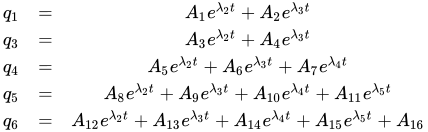
where is related to . The time course of the quantity of tracer in each compartment is shown below:


The quantity of tracer in the overall kidney can be obtained by summing the renal parenchyma and renal pelvis curves, so that:

as shown below:

What is recorded in a renogram in practice is not just this kidney curve, but also the quantity of tracer in:
- overlapping and underlying tissues, and in
- the intravascular space of the kidney itself.
These contributions add a background upon which the true renogram is superimposed. The quantity of tracer in this background varies with time, but not in the same way as the true renal curve. The time course of this background is likely to behave in a manner similar to the sum of the intravascular () and extravascular () curves dervied earlier using this five compartment model.

The following equation can be derived on this basis:

where and represent the contributions to the detected renogram curve from the tracer in the intravascular and extravascular spaces, respectively. For example, the curves below were generated using und und




In practice, this background curve should be subtracted from the raw renogram data to obtain a curve which reflects the true quantity of tracer in the kidney (see the previous figure). This process is sometimes referred to as blood background subtraction - although you should now be able to appreciate that this is a bit of a misnomer!
The uncorrected and corrected curves are shown below to assist with direct comparison:
|
|
and an example from a patient's renogram is shown in the following figure, to assist you in comparing them with the predictions from compartmental analysis:
 |
 |
A final figure illustrates a form of analysis that can be used in 99mTc-MAG3 renography in a patient with obstructive uropathy:

Background Subtraction in Renography[Bearbeiten]
In practice, the background activity in a renogram must be taken into account when interpreting a renogram. This is generally achieved by estimating the background activity and subtracting it from the raw renogram data. The question is: how can this background activity be measured?
One method has been based on recording the activity at nephrectomy sites in patients whose remaining kidney is being examined. However, it should be noted that removal of a kidney also removes an intravascular source of the background activity. As a result, nephrectomy sites commonly appear colder than the extra-renal tissues in renogram images.
A potentially better method is to record the activity in the region of a non-functioning kidney.
In most patients, however, a non-renal region must be used for background estimation. Ideally, the choice of region should reflect the same intra- and extravascular background as the kidney itself. There appears to be no standardization in this area, with practices including the use of a region between the kidneys, above the kidneys, over the heart, or below each kidney.
Once the background region is selected and the activity/time curves are generated, the background curve should be scaled by a factor dependent on the relative areas of the background and renal regions, prior to subtraction from the raw renogram curve. In addition, note that some practices also involve further scaling of the background curve depending on the kidney location. Finally, more sophisticated methods of background correction have been developed and include:
- the generation of interpolated background regions from samples of the background around the kidney,
- the estimation of background correction factors using extrapolation techniques, and
- deconvolution analysis.
Relative Niernfunktion[Bearbeiten]
Die relative Nierenfunktion wird im allgemeinen als prozentualer Anzeil der Clearance einer Niere an der Gesmatcleance der Nieren des Patieren definiert. Demnach ist:

und

wobei LN and RN sich entsprechend auf die rechte und linke Niere beziehen.
Es sein:
- : Hintergrundkorregierte Zählrate der Niere

- : Zählrate einer betrachteten intravasulären Region.
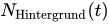
An dieser Stelle erkennt man dass:

Wir können daher schließen dass in der Anfangsphase des Renogramms, d.h. solange gilt:

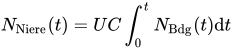
wobei die Uptake Konstante der Niere ist. Diese Konstante hängt mit der Clearance Rate der Niere zusammen und wir können daher schreiben:


und

Wir haben jedoch bereits oben gesehen das die hintergrundkorrigierte Renale Zählrate direkt mit der Uptake Konstante verknüpft ist und wir können daher schließen dass:

Man beachte dass diese Analyse nahelegt dass die relative Nierenfunktion aus der Messung der relativen Zählrate in jeder Niere nach dem anfänglichen Vaskulären Maximum aber vor dem Beginn der Ausscheidungsphase erfolgen kann.