Ing Mathematik: Vektoren

Aus Wikibooks

Wechseln zu: Navigation, Suche
Wikibooks buchseite.svg Zurück zu Permutationen, ... | One wikibook.svg Hoch zu Gesamtinhaltsverzeichnis | Wikibooks buchseite.svg Vor zu Matrizen


Inhaltsverzeichnis

[Bearbeiten] Vektorraum

Ein Vektorraum \mathbb{R}^n sei die Menge aller geordneter n-Tupel von reellen Zahlen. Ein Element eines Vektorraumes heißt Vektor
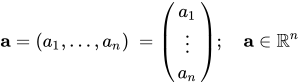
\mathbf{a}=(a_1, \ldots, a_n)\ = 
\begin{pmatrix}
a_1 \\
\vdots \\
a_n
\end{pmatrix}
 ; \quad \mathbf{a}\in \mathbb{R}^n

mit den Koordinaten des Vektors

a_1, \ldots, a_n \ ; \quad a_i \in \mathbb{R}


Vektoren weisen einen Zahlenwert (Betrag) und eine Richtung auf. Skalare haben nur einen Zahlenwert.

Freie Vektoren können beliebig im Raum verschoben werden. Ortsvektoren (gebundene Vektoren) sind ortsgebunden.


[Bearbeiten] Addition von Vektoren

Vektor add.png

\mathbf{a}=(a_1,\ldots,a_n) \in \mathbb{R}^n

\mathbf{b}=(b_1,\ldots,b_n) \in \mathbb{R}^n


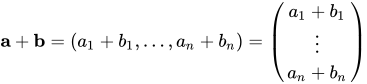
\mathbf{a}+\mathbf{b} = \left(a_1+b_1, \ldots , a_n+b_n\right) =
\begin{pmatrix}
a_1+b_1 \\
\vdots \\
a_n+b_n
\end{pmatrix}


[Bearbeiten] Assoziativgesetz

(\mathbf{a}+\mathbf{b})+\mathbf{c} = \mathbf{a} + (\mathbf{b}+\mathbf{c})


[Bearbeiten] Kommutativgestz

\mathbf{a}+\mathbf{b} = \mathbf{b} + \mathbf{a}

[Bearbeiten] Nullvektor

Der Nullvektor ist das neutrale Element der Vektoraddition.

\mathbf{o}=(0,\ldots,0) \in \mathbb{R}^n

\mathbf{o}+\mathbf{a} = \mathbf{a}+\mathbf{o} = \mathbf{a}


[Bearbeiten] Differenzvektor

\mathbf{a}+\mathbf{c}=\mathbf{b} läßt sich stets umformen zu \mathbf{c} =
\mathbf{b}-\mathbf{a}. \mathbf{c} sei in diesem Fall der Differenzvektor.


[Bearbeiten] Beispiel

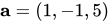
Gegeben seien die Vektoren \mathbf{a}=(1,-1,5) und \mathbf{b}=(2,0,1). Gesucht sind \mathbf{a}+\mathbf{b} und \mathbf{a}-\mathbf{b}.


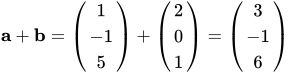
\mathbf{a}+\mathbf{b} = 
\begin{pmatrix}
1 \\
-1 \\
5
\end{pmatrix}
+
\begin{pmatrix}
2 \\
0 \\
1
\end{pmatrix}
=
\begin{pmatrix}
3 \\
-1 \\
6
\end{pmatrix}


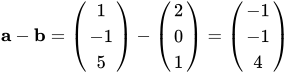
\mathbf{a}-\mathbf{b} = 
\begin{pmatrix}
1 \\
-1 \\
5
\end{pmatrix}
-
\begin{pmatrix}
2 \\
0 \\
1
\end{pmatrix}
=
\begin{pmatrix}
-1 \\
-1 \\
4
\end{pmatrix}


[Bearbeiten] Multiplikation eines Vektors mit einem Skalar

Geometrisch entspricht die Multiplikation eines Vektors mit einem Skalar der Streckung eines Vektors.

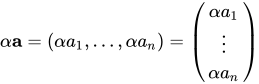
\alpha , \; \beta \ \in \mathbb{R}


 \alpha \mathbf{a} = \left( \alpha a_1, \ldots , \alpha a_n\right)=
\begin{pmatrix}
\alpha a_1 \\
\vdots \\
\alpha a_n
\end{pmatrix}

 1\mathbf{a} = \mathbf{a}


[Bearbeiten] Assoziativgesetz

(\alpha\beta) \mathbf{a} = \alpha (\beta \mathbf{a})


[Bearbeiten] Distributivgesetze

(\alpha + \beta) \mathbf{a} = \alpha \mathbf{a} + \beta \mathbf{a}

\alpha (\mathbf{a} + \mathbf{b}) = \alpha \mathbf{a} + \alpha \mathbf{b}


[Bearbeiten] Gegenvektor

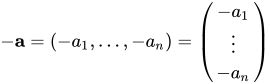
-\mathbf{a} = \left( -a_1, \ldots, -a_n\right) =
\begin{pmatrix}
-a_1 \\
\vdots \\
-a_n
\end{pmatrix}

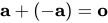
\mathbf{a} + (-\mathbf{a}) = \mathbf{o}


[Bearbeiten] Parallelität

Die zwei Vektoren a und b sind dann parallel, wenn gilt

 \mathbf{a} = \lambda \mathbf{b}\ ; \quad \lambda \in \mathbb{R} \wedge \lambda\neq 0

λ > 0: gleichsinnig parallel

λ < 0: gegensinnig parallel


[Bearbeiten] Beispiel

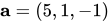
Sind die Vektoren \mathbf{a}=(5,1,-1) und \mathbf{b}=12(4,1,-1)-(63,15,-15) zueinander parallel?


\mathbf{b} = 12
\begin{pmatrix}
4 \\
1 \\
-1
\end{pmatrix}
-
\begin{pmatrix}
63 \\
15 \\
-15
\end{pmatrix}
=
\begin{pmatrix}
-15 \\
-3 \\
3
\end{pmatrix}
=-3
\begin{pmatrix}
5 \\
1 \\
-1
\end{pmatrix}

\Rightarrow \; \mathbf{b} = -3\mathbf{a}\; \Rightarrow \;\mathbf{a} || \mathbf{b}.


[Bearbeiten] Skalarprodukt

Gegeben sind zwei Vektoren

\mathbf{a}=(a_1,\ldots,a_n) \in \mathbb{R}^n

\mathbf{b}=(b_1,\ldots,b_n) \in \mathbb{R}^n

Das Skalarprodukt ergibt sich zu

\mathbf{a}\cdot \mathbf{b}=\sum_{i=1}^n a_ib_i

  • Das Skalarprodukt ordnet einem Paar von Vektoren eine reelle Zahl zu.
  • Das Skalarprodukt unterscheidet sich grundlegend von der Multiplikation reeller Zahlen oder der Multiplikation eines Vektors mit einem Skalar.


Mittels Skalarprodukt lassen sich lineare Funktionen einfach anschreiben

f(x)=a_1x_1 + a_2x_2 + \ldots + a_nx_n = \mathbf{a}\cdot\mathbf{x}


[Bearbeiten] Norm eines Vektors

Die Norm (Länge) eines Vektors a ist gegeben durch

\|\mathbf{a}\| = \sqrt{\mathbf{a}\cdot \mathbf{a}} = \sqrt{a_1^2+\cdots + a_n^2}

\|\alpha \mathbf{a}\| = |\alpha| \| \mathbf{a}\|


Vektoren mit der Länge Eins heißen Einheitsvektoren. Normiert man einen Vektor a, so bringt man ihn auf die Länge Eins

\mathbf{a}_0 = \frac{\mathbf{a}}{\|\mathbf{a}\|}


Das Skalarprodukt ist auch definiert durch

 \mathbf{a}\cdot \mathbf{b}= \|\mathbf{a}\| \|\mathbf{b}\|\cos(\angle)

wobei \angle den Winkel zwischen den Vektoren a und b bezeichnet.


[Bearbeiten] Kommutativgesetz

 \mathbf{a}\cdot \mathbf{b} = \mathbf{b}\cdot \mathbf{a}


[Bearbeiten] Assoziativgesetz gilt nicht

 \mathbf{a}\cdot(\mathbf{b} \cdot \mathbf{c}) \neq (\mathbf{a}\cdot\mathbf{b}) \cdot
\mathbf{c}


[Bearbeiten] Distributivgesetz

 \mathbf{a}\cdot(\mathbf{b} + \mathbf{c}) = \mathbf{a}\cdot\mathbf{b} + \mathbf{a} \cdot
\mathbf{c}


[Bearbeiten] Chauchy-Schwarzsche Ungleichung

(\mathbf{a}\cdot \mathbf{b})^2 \le \|\mathbf{a}\|^2\|\mathbf{b}\|^2


[Bearbeiten] Dreiecksungleichung

\|\mathbf{a}+ \mathbf{b}\| \le \|\mathbf{a}\| + \|\mathbf{b}\|


[Bearbeiten] Beispiel: Parallelogrammgleichung

Vektoren parallelogramm.png

Es ist folgende Gleichung herzuleiten

\|\mathbf{a}+\mathbf{b}\|^2 + \|\mathbf{a}-\mathbf{b}\|^2= 2\left( \|\mathbf{a}\|^2 + \|\mathbf{b}\|^2\right)


Lösung:

\|\mathbf{a}+\mathbf{b}\|^2 = (\mathbf{a}+\mathbf{b})\cdot(\mathbf{a}+\mathbf{b})

\|\mathbf{a}-\mathbf{b}\|^2 = (\mathbf{a}-\mathbf{b})\cdot(\mathbf{a}-\mathbf{b})

\|\mathbf{a}+\mathbf{b}\|^2 + \|\mathbf{a}-\mathbf{b}\|^2= \mathbf{a}\mathbf{a} + \mathbf{a}\mathbf{b} +\mathbf{a}\mathbf{b} + \mathbf{b}\mathbf{b} + \mathbf{a}\mathbf{a} - \mathbf{a}\mathbf{b} - \mathbf{a}\mathbf{b} + \mathbf{b}\mathbf{b} = 2\mathbf{a}\mathbf{a} + 2\mathbf{b}\mathbf{b}


und somit, wie zu zeigen war

\|\mathbf{a}+\mathbf{b}\|^2 + \|\mathbf{a}-\mathbf{b}\|^2= 2\left( \|\mathbf{a}\|^2 + \|\mathbf{b}\|^2\right)


[Bearbeiten] Orthogonalität

Zwei Vektoren a, b heißen orthogonal (= senkrecht), wenn  \mathbf{a}\cdot \mathbf{b} = 0 gilt.

Man schreibt dies auch als \mathbf{a}\bot \mathbf{b} .

Es gilt dann der Satz von Pythagoras

\|\mathbf{a}+ \mathbf{b}\|^2 = \|\mathbf{a}\|^2 + \|\mathbf{b}\|^2


[Bearbeiten] Orthogonalsystem

Die Vektoren \mathbf{a}_i\in \mathbb{R}^n bilden ein Orthogonalsystem, wenn

  1.  \forall i \quad \mathbf{a}_i\ne \mathbf{o}
  2.  \forall (i\ne j) \quad \mathbf{a}_i\cdot \mathbf{a}_j=0

Gilt zusätzlich noch

 \forall i: \; \|\mathbf{a}_i\| = 1

dann bilden die Vektoren ein Orthonormalsystem.


[Bearbeiten] Gram-Schmidtsches Orthogonalisierungsverfahren

Wikipedia: Gram-Schmidtsches Orthogonalisierungsverfahren


[Bearbeiten] Beispiel: Satz von Thales

Es ist der Satz von Thales "Jeder Peripheriewinkel über dem Durchmesser eines Kreises beträgt 90°" zu überprüfen.


Lösung:

Vektoren thales.png


\mathbf{a} = \mathbf{r} + \mathbf{c}

\mathbf{b} = \mathbf{r} - \mathbf{c}

\|\mathbf{r}\| = \|\mathbf{c}\|


\mathbf{a}\cdot\mathbf{b} = (\mathbf{r} + \mathbf{c})\cdot(\mathbf{r} - \mathbf{c}) = \mathbf{r}\mathbf{r} + \mathbf{r}\mathbf{c} - \mathbf{r}\mathbf{c} - \mathbf{c}\mathbf{c} = \|\mathbf{r}\|^2 - \|\mathbf{c}\|^2 = 0

\Rightarrow\; \mathbf{a} \bot \mathbf{b}


[Bearbeiten] Linearkombinationen

Den Vektor

 \mathbf{b} = \alpha_1 \mathbf{a}_1 + \ldots + \alpha_n \mathbf{a}_n

nennt man Linearkombination aus den Vektoren \mathbf{a}_1, \ldots, \mathbf{a}_n \; \in \mathbb{R}^n.


Ist  \mathbf{b}=0, so nennt man die Vektoren \mathbf{a}_1, \ldots, \mathbf{a}_n

  • linear abhängig, wenn \exists i: \; \alpha_i\ne 0
  • linear unabhängig, wenn \forall i: \; \alpha_i = 0


[Bearbeiten] Natürliche Basis

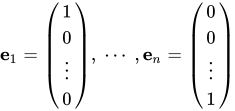
Die Einheitsvektoren (Basisvektoren)


\mathbf{e}_1=
\begin{pmatrix}
1 \\
0 \\
\vdots \\
0
\end{pmatrix}
, \;
\cdots \; ,
\mathbf{e}_n=
\begin{pmatrix}
0 \\
0 \\
\vdots \\
1
\end{pmatrix}

nennt man natürliche Basis des \mathbb{R}^n.

Für diese Basisvektoren gilt das sogenannte Kronecker-Delta

\delta_{ij} = \mathbf{e}_i \cdot \mathbf{e}_j = 
\begin{cases}
1, & \mbox{wenn}\ i=k \\
0, & \mbox{wenn}\ i\ne k
\end{cases}


Für einen beliebigen Vektor \mathbf{x} = \left( x_1,\ldots ,x_n\right) \in \mathbb{R}^n gilt

 \mathbf{x} = x_1 \mathbf{e}_1 + \ldots + x_n \mathbf{e}_n


x_1 \mathbf{e}_1, \ldots, x_n \mathbf{e}_n nennt man die Komponenten des Vektors bezüglich der natürlichen Basis des \mathbb{R}^n.


[Bearbeiten] Richtungskosinus

 \mathbf{x}\cdot \mathbf{e}_i = \|\mathbf{x}\| \cos\alpha_i

daraus folgt

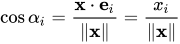
\cos\alpha_i = \frac{\mathbf{x}\cdot \mathbf{e}_i}{\|\mathbf{x}\|} = \frac{x_i}{\|\mathbf{x}\|}


[Bearbeiten] Beispiel

Gesucht ist der Winkel, den der Vektor \mathbf{a}=(3,-1,-5) mit dem Basisvektor \mathbf{e}_1 einschließt.


Lösung:

\mathbf{a}\cdot\mathbf{e}_1 = \|\mathbf{a}\|\cos\angle

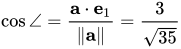
\cos\angle = \frac{\mathbf{a}\cdot\mathbf{e}_1}{\|\mathbf{a}\|} = \frac{3}{\sqrt{35}}

\angle = 1,04\ {\rm rad}


[Bearbeiten] Projektionen

Vektor proj.png


Unter Projektion ist hier die Orthogonalprojektion gemeint.

[Bearbeiten] Skalare Projektion

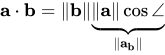
\mathbf{a}\cdot \mathbf{b} = \|\mathbf{b}\| \underbrace{\|\mathbf{a}\| \cos \angle}_{\|\mathbf{a}_{\mathbf{b}}\|}


Daraus folgt die Gleichung für die skalare Projektion des Vektors a auf b
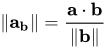
\|\mathbf{a}_{\mathbf{b}}\| = \frac{\mathbf{a}\cdot \mathbf{b}}{\|\mathbf{b}\|}


[Bearbeiten] Vektorprojektion

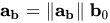
\mathbf{a}_{\mathbf{b}} = \|\mathbf{a}_{\mathbf{b}}\|\ \mathbf{b}_0

\mathbf{b}_0 = \frac{\mathbf{b}}{\|\mathbf{b}\|}


Daraus folgt

\mathbf{a}_{\mathbf{b}} = \frac{\mathbf{a}\cdot \mathbf{b}}{\|\mathbf{b}\|^2} \mathbf{b}


[Bearbeiten] Beispiel

Gegeben ist ein Vektor \mathbf{a}=(3,-1,-5). Gesucht ist der Winkel, den die Orthogonalprojektion des Vektors a auf die \mathbf{e}_1\mathbf{e}_2-Ebene mit dem \mathbf{e}_1-Basisvektor einschließt.


Lösung:

Vektoren projektion e1e2.png

\mathbf{a}_1 = \frac{\mathbf{a}\cdot\mathbf{e}_1}{\|\mathbf{e}_1\|}\mathbf{e}_1 = a_1\mathbf{e}_1 = (3,0,0)

\mathbf{a}_2 = \frac{\mathbf{a}\cdot\mathbf{e}_2}{\|\mathbf{e}_2\|}\mathbf{e}_2 = a_2\mathbf{e}_2 = (0,-1,0)

\mathbf{a}_{12} = \mathbf{a}_1 + \mathbf{a}_2 = (3,-1,0)

Dieses Zwischenergebnis hätte man natürlich auch direkt aus der Skizze ermitteln können, dann wäre aber der Witz dieses Beispiels verloren gegangen.
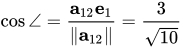

\cos\angle = \frac{\mathbf{a}_{12}\mathbf{e}_{1}}{\|\mathbf{a}_{12}\|} = \frac{3}{\sqrt{10}}

\angle = 0,32\ {\rm rad}


[Bearbeiten] Vektorprodukt

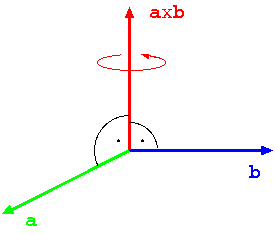
Vektor vprodukt.png

Das Vektorprodukt zweier linear unabhängiger Vektoren ist nur für den euklidischen Raum \mathbb{R}^3 definiert.

\mathbf{a}\times \mathbf{b} = \left( a_2b_3-a_3b_2,\ a_3b_1-a_1b_3,\ a_1b_2-a_2b_1\right)


Die Vektoren \mathbf{a}, \mathbf{b}, \mathbf{a}\times \mathbf{b} bilden ein Rechtssystem.


[Bearbeiten] Regeln

  • Das Vektorprodukt ist nicht kommutativ: \mathbf{a}\times \mathbf{b} = -(\mathbf{a}\times \mathbf{b})

  • Orthogonalität: (\mathbf{a}\; \bot \; \mathbf{a}\times \mathbf{b}) \wedge (\mathbf{b}\; \bot \; \mathbf{a}\times \mathbf{b})
  • Parallelität: \mathbf{a} \times \mathbf{b}=\mathbf{o} \Leftrightarrow \begin{cases} \mathbf{a}=\mathbf{o}\; \vee \; \mathbf{b}=\mathbf{o} \\ \mathbf{a} \| \mathbf{b} \end{cases}
  • Lagrangesche Identität: \|\mathbf{a}\times \mathbf{b}\|^2 = \| \mathbf{a}\|^2 \| \mathbf{b}\|^2 - (\mathbf{a}\cdot \mathbf{b})^2
  • Parallelogramm: F_\Diamond = \|\mathbf{a}\|\|\mathbf{b}\| \sin \angle = \|\mathbf{a}\times \mathbf{b}\| ist der Flächeninhalt des von den Vektoren \mathbf{a}, \mathbf{b} aufgespannten Parallelogrammes. \angle ist der von a und b eingeschlossene Winkel.
  • Distributivgesetz: (\mathbf{a} + \mathbf{b})\times \mathbf{c} = (\mathbf{a} \times \mathbf{b}) + (\mathbf{b} \times \mathbf{c})
  • \mathbf{a} \times (\mathbf{b}\times \mathbf{c}) = (\mathbf{a} \cdot \mathbf{c})\mathbf{b} + (\mathbf{a} \cdot \mathbf{b})\mathbf{c}

[Bearbeiten] Rechnungen

\mathbf{A} \times \mathbf{B} =\begin{pmatrix} a_1 \\ a_2 \\ a_3 \end{pmatrix} \times\begin{pmatrix} b_1 \\ b_2 \\ b_3 \end{pmatrix}=
\begin{pmatrix} a_2  b_3 - a_3 b_2 \\ a_3 b_1 - a_1 b_3 \\ a_1 b_2 - a_2 b_1 \end{pmatrix}

\mathbf{A} \times \mathbf{A} =
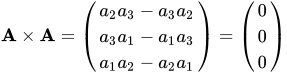
\begin{pmatrix} a_2 a_3 - a_3 a_2 \\ a_3 a_1 - a_1 a_3 \\ a_1 a_2 - a_2 a_1 \end{pmatrix}= \begin{pmatrix} 0 \\ 0 \\ 0 \end{pmatrix}

\mathbf{B} \times \mathbf{A} =
\begin{pmatrix} b_2  a_3 - b_3 a_2 \\ b_3 a_1 - b_1 a_3 \\ b_1 a_2 - b_2 a_1  \end{pmatrix}
=- \begin{pmatrix} a_2  b_3 - a_3 b_2 \\ a_3 b_1 - a_1 b_3 \\ a_1 b_2 - a_2 b_1 \end{pmatrix}
=-\mathbf{A} \times \mathbf{B}


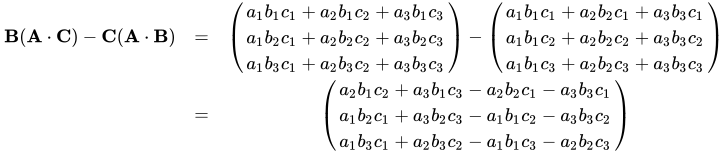
\begin{matrix}
\mathbf{B}(\mathbf{A} \cdot \mathbf{C})- \mathbf{C}(\mathbf{A}\cdot \mathbf{B})
&=&\begin{pmatrix} a_1 b_1 c_1 + a_2 b_1 c_2 + a_3 b_1 c_3 \\ 
                 a_1 b_2 c_1 + a_2 b_2 c_2 + a_3 b_2 c_3 \\ 
                 a_1 b_3 c_1 + a_2 b_3 c_2 + a_3 b_3 c_3 \\ 
\end{pmatrix} -
\begin{pmatrix} a_1 b_1 c_1 + a_2 b_2 c_1 + a_3 b_3 c_1 \\
                a_1 b_1 c_2 + a_2 b_2 c_2 + a_3 b_3 c_2 \\
                a_1 b_1 c_3 + a_2 b_2 c_3 + a_3 b_3 c_3 
\end{pmatrix} \\
&=&
\begin{pmatrix}  a_2 b_1 c_2 + a_3 b_1 c_3 - a_2 b_2 c_1 - a_3 b_3 c_1 \\ 
                 a_1 b_2 c_1 + a_3 b_2 c_3 - a_1 b_1 c_2 - a_3 b_3 c_2  \\ 
                 a_1 b_3 c_1 + a_2 b_3 c_2 - a_1 b_1 c_3 - a_2 b_2 c_3  
\end{pmatrix} 
\end{matrix}

\begin{matrix}
\mathbf{A} \times (\mathbf{B} \times \mathbf{C}) &=& 
\begin{pmatrix} a_1 \\ a_2 \\ a_3 \end{pmatrix} \times
\begin{pmatrix} b_2 c_3 - b_3 c_2 \\ b_3 c_1 - b_1 c_3 \\ b_1 c_2 - b_2 c_1 \end{pmatrix} &=&
\begin{pmatrix} a_2 b_1 c_2 - a_2 b_2 c_1 - a_3 b_3 c_1 + a_3 b_1 c_3 \\
                a_3 b_2 c_3 - a_3 b_3 c_2 - a_1 b_1 c_2 + a_1 b_2 c_1 \\
                a_1 b_3 c_1 - a_1 b_1 c_3 - a_2 b_2 c_3 + a_2 b_3 c_2
 \end{pmatrix} \\ &=&
\mathbf{B}(\mathbf{A} \cdot \mathbf{C})- \mathbf{C}(\mathbf{A}\cdot \mathbf{B})  & &
\end{matrix}

εijk

\left(\mathbf{A} \times \mathbf{B}\right)_i=\epsilon_{ijk} \mathbf{A}_j  \mathbf{B}_k

[Bearbeiten] Beispiel

Gesucht ist ein normierter Normalenvektor auf die beiden Vektoren \mathbf{a}=(1,1,0),\  \mathbf{b}=(5,4,1).


Lösung:

\mathbf{n} = \mathbf{a} \times \mathbf{b} = \left( a_2b_3-a_3b_2,\ a_3b_1-a_1b_3,\ a_1b_2-a_2b_1\right) =  (1, -1, -1)

\|\mathbf{n}\| = \sqrt{3}

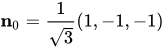
\mathbf{n}_0=\frac{1}{\sqrt{3}}(1,-1,-1)


[Bearbeiten] Spatprodukt

Das Spatprodukt der Vektoren \mathbf{a},\mathbf{b},\mathbf{c}\in \mathbb{R}^3 ist definiert als

\mathcal{h}\mathbf{a},\mathbf{b},\mathbf{c}\mathcal{i} = (\mathbf{a}\times \mathbf{b})\cdot \mathbf{c}


[Bearbeiten] Regeln

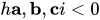
  • Unabhängigkeit: Die Vektoren a, b, c sind linear unabhängig,wenn \mathcal{h}\mathbf{a},\mathbf{b},\mathbf{c}\mathcal{i} \ne 0
  • Rechtssystem: \mathcal{h}\mathbf{a},\mathbf{b},\mathbf{c}\mathcal{i} > 0
  • Linkssystem: \mathcal{h}\mathbf{a},\mathbf{b},\mathbf{c}\mathcal{i} < 0
  • Spatvolumen: V_{spat} = |\mathcal{h}\mathbf{a},\mathbf{b},\mathbf{c}\mathcal{i}|
  • Vertauschungssatz: \mathcal{h}\mathbf{a},\mathbf{b},\mathbf{c}\mathcal{i} = \mathcal{h}\mathbf{b},\mathbf{c},\mathbf{a}\mathcal{i} = \mathcal{h}\mathbf{c},\mathbf{a},\mathbf{b}\mathcal{i} = -\mathcal{h}\mathbf{b},\mathbf{a},\mathbf{c}\mathcal{i} = -\mathcal{h}\mathbf{a},\mathbf{c},\mathbf{b}\mathcal{i} = -\mathcal{h}\mathbf{c},\mathbf{b},\mathbf{a}\mathcal{i}


[Bearbeiten] Geraden

[Bearbeiten] Gerade durch Punkt und Richtung

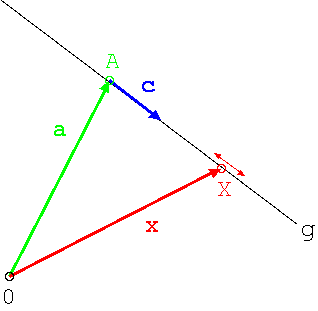
Vektor gerade.png


Gegeben sei ein Punkt A (Ortsvektor a) und ein Richtungsvektor c. Der Punkt X liegt auf der Geraden g (X\in g) wenn,

g: \; \mathbf{x} = \mathbf{a} + \lambda \mathbf{c}, \quad \lambda \in \mathbb{R}\; \wedge\; \mathbf{a},\mathbf{c} \in \mathbb{R}^n

Obige Gleichung nennt man auch eine Parameterdarstellung (Parameter λ).


[Bearbeiten] Gerade durch zwei Punkte

Vektor gerade2.png


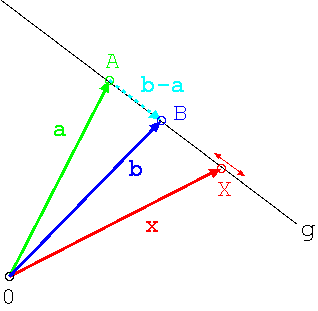
Die Gerade sei durch die Punkte A und B gegeben (Ortsvektoren a,b). Der Punkt X liegt auf der Geraden g (X\in g) wenn,

g: \; \mathbf{x} = \mathbf{a} + \lambda (\mathbf{b}-\mathbf{a}), \quad \lambda \in \mathbb{R}\; \wedge\; \mathbf{a},\mathbf{b} \in \mathbb{R}^n

Die Punkte A, B und X heißen kollinear, d.h. diese drei Punkte liegen auf der gleichen Geraden.


[Bearbeiten] Ebenen

[Bearbeiten] Ebene durch einen Punkt und zwei Richtungen

Vektor ebene.png


Gegeben sei ein Punkt A (Ortsvektor a) und zwei Richtungsvektoren c,d. Der Punkt X liegt in der Ebene E (X\in E) wenn,

E: \; \mathbf{x} = \mathbf{a} + \lambda \mathbf{c} + \mu \mathbf{d}, \quad \lambda,\mu \in \mathbb{R}\; \wedge\; \mathbf{a},\mathbf{c},\mathbf{d} \in \mathbb{R}^n

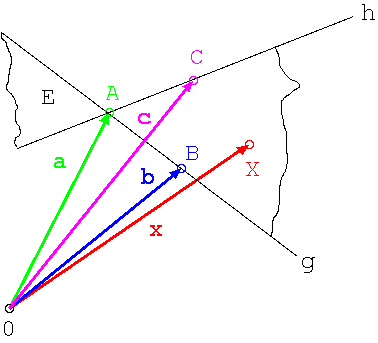
Die Ebene E wird also durch die zwei Geraden g und h aufgespannt.


[Bearbeiten] Ebene durch drei Punkte

Vektor ebene2.png


Gegeben seinen drei Punkte A, B und C (Ortsvektoren a,b,c). Der Punkt X liegt in der der Ebene E (X\in E) wenn,

E: \; \mathbf{x} = \mathbf{a} + \lambda (\mathbf{b}-\mathbf{a}) + \mu (\mathbf{c}-\mathbf{a}), \quad \lambda,\mu \in \mathbb{R}\; \wedge\; \mathbf{a},\mathbf{b},\mathbf{c} \in \mathbb{R}^n


Die Ebene kann in diesem Fall auch über das Spatprodukt definiert werden:

V_{Spat} = |\mathcal{h}\mathbf{x}-\mathbf{a},\; \mathbf{b}-\mathbf{a},\; \mathbf{c}-\mathbf{a} \mathcal{i}|


Da die Punkte B, C und X in einer Ebene liegen, ist VSpat = 0 und

E:\; \mathcal{h}\mathbf{x}-\mathbf{a},\; \mathbf{b}-\mathbf{a},\; \mathbf{c}-\mathbf{a} \mathcal{i} = 0


[Bearbeiten] Hessesche Normalform

Vektor ebene3.png


n sei ein Normalenvektor zur Ebene E. Es gilt \mathbf{n}\; \bot \; (\mathbf{x}-\mathbf{a}), und somit

\mathbf{n} \cdot (\mathbf{x}-\mathbf{a}) = 0

Dividiert man diese Gleichung durch die Norm des Normalenvektors \|\mathbf{n}\|, so erhält man die Ebenengleichung in der Hesseschen Normalform

E: \mathbf{n}_0 \cdot (\mathbf{x}-\mathbf{a}) = 0


[Bearbeiten] In Koordinatenschreibweise

Aus der Parameterdarstellung

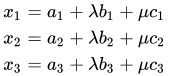
E: \mathbf{x} = \mathbf{a} + \lambda\mathbf{b} + \mu\mathbf{c}\ ; \quad \mathbf{a},\mathbf{b},\mathbf{c},\mathbf{x}\in\mathbb{R}^3

erhält man in Koordinaten angeschrieben

\begin{matrix}
x_1 = a_1 + \lambda b_1 + \mu c_1 \\
x_2 = a_2 + \lambda b_2 + \mu c_2 \\
x_3 = a_3 + \lambda b_3 + \mu c_3 \\
\end{matrix}

Eliminiert man \lambda,\ \mu aus diesen Gleichungen, so erhält man die sogenannte Abschnittsform der Ebenengleichung

E:\; ax + by +cz = d


[Bearbeiten] Anwendungen: Punkte, Geraden und Ebenen

[Bearbeiten] Winkel zwischen Geraden

Vektoren geraden winkel.png


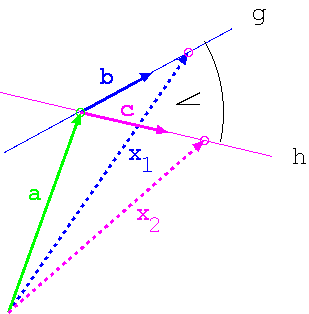
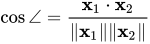
Gegeben sind zwei Geraden im \mathbb{R}^3

g: \mathbf{x}_1 = \mathbf{a} + \lambda \mathbf{b}

h: \mathbf{x}_2 = \mathbf{a} + \mu \mathbf{c}


Den Winkel zwischen den beiden Geraden g und h kann man über das Skalarprodukt gewinnen
\cos\angle = \frac{\mathbf{x}_1\cdot\mathbf{x}_2}{\|\mathbf{x}_1\|\|\mathbf{x}_2\|}


[Bearbeiten] Normale: Abstand Punkt - Ebene

Vektoren punkt ebene.png


Gegeben sei ein Punkt P und eine Ebene E. D sei der Durchstoßpunkt von n durch die Ebene E.


Der Abstand von Punkt P zu Ebene E ist \delta = \overline{PD} = \|\mathbf{p} - \mathbf{d}\|


Direkt aus der Abbildung oder auch mittels der Hesseschen Ebenengleichung ergibt sich

(\mathbf{d}-\mathbf{a})\cdot \mathbf{n} = 0

Weiters ist

\mathbf{d} = \mathbf{p} + \lambda\mathbf{n}


Aus den beiden vorigen Gleichungen kann man nun λ ermitteln

(\mathbf{p}+\lambda\mathbf{n}-\mathbf{a}) \mathbf{n}=0

(\mathbf{p}-\mathbf{a})\mathbf{n} + \lambda\mathbf{n}\mathbf{n}=0

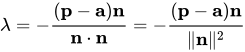
\lambda = -\frac{(\mathbf{p}-\mathbf{a})\mathbf{n}}{\mathbf{n}\cdot\mathbf{n}} = -\frac{(\mathbf{p}-\mathbf{a})\mathbf{n}}{\|\mathbf{n}\|^2}


Und somit ist

\delta = \|\mathbf{p} - \mathbf{p} + \frac{(\mathbf{p}-\mathbf{a})\mathbf{n}}{\|\mathbf{n}\|^2}\mathbf {n}\| = \|\underbrace{(\mathbf{p}-\mathbf{a})\mathbf{n}_0}_k \mathbf {n_0}\| = |k|\|\mathbf{n}_0\| = |k|  = |(\mathbf{p}-\mathbf{a})\mathbf{n}_0|


[Bearbeiten] Gerade als Schnitt zweier Ebenen

Vektoren zwei ebenen.png


Eine Gerade im Raum \mathbb{R}^3 kann man auch in der Form

g = 
\begin{cases}
E_1:\ a_1x_1 + a_2x_2 + a_3x_3 = c \\
E_2:\ b_1x_1 + b_2x_2 + b_3x_3 = d
\end{cases}

darstellen. Natürlich dürfen die Ebenen hierbei nicht parallel liegen.


Beispiel: Gegeben sei eine Gerade \mathbf{x} = \mathbf{a}+\lambda \mathbf{b} mit \mathbf{a}=(1,1,0),\ \mathbf{b}=(3,4,-2),\ \lambda\in\mathbb{R}. Gesucht sind die beiden Ebenen, welche g als Schnittgerade besitzen.


x_1 =\ 1 + 3\lambda

x_2 =\ 1 + 4\lambda

x_3 =\ -2\lambda


Daraus folgt

\lambda = -\frac{x_3}{2}


und schließlich ist

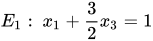
E_1:\ x_1 + \frac{3}{2}x_3 = 1

E_2:\ x_2 + 2x_3 = 1


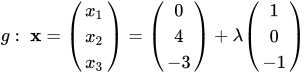
Beispiel: Gegeben seinen zwei Ebenen E_1:\; x_1+x_2+x_3=1;\;E_2:\; x_1+x_3 = -3 . Gesucht ist die Schnittgerade in Parameterdarstellung.


Wir wählen z.B.: x_1 =\ \lambda

und berechnen sukzessive

x_3 =\ -3 - \lambda

x_2 =\ 4


Somit ist die Darstellung der Geraden in Parameterform
g:\;\mathbf{x} = 
\begin{pmatrix}
x_1\\
x_2\\
x_3
\end{pmatrix}
=
\begin{pmatrix}
0\\
4\\
-3
\end{pmatrix}
+ \lambda
\begin{pmatrix}
1\\
0\\
-1
\end{pmatrix}


[Bearbeiten] Durchstoßpunkt einer Geraden durch eine Ebene

Es gibt drei Möglichkeiten:

  • Die Gerade g schneidet die Ebene E in einem Punkt
  • Die Gerade liegt parallel zur Ebene, aber nicht in der Ebene
  • Die Gerade liegt in der Ebene


Beispiel: Gegeben sei eine Gerade g:\;
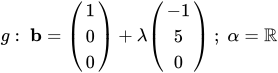
\mathbf{b}=
\begin{pmatrix}
1\\
0\\
0
\end{pmatrix}
+ \lambda
\begin{pmatrix}
-1\\
5\\
0
\end{pmatrix}
\ ;\; \alpha=\mathbb{R} und eine Ebene E:\; x_1+x_2+x_3=0. Der Durchstosspunkt der Gerade durch die Ebene soll berechnet werden.


Gerade g:

x_2=\ 5\left(1-x_1\right)

x_3=\ 0


Ebene E:

x_1+x_2+x_3=\ 0


Das sind drei Gleichungen für drei Unbekannte, aufgelöst

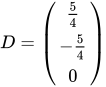
Durchstosspunkt D=
\begin{pmatrix}
\frac{5}{4}\\
-\frac{5}{4}\\
0
\end{pmatrix}


[Bearbeiten] Winkel zwischen einer Geraden und einer Ebene

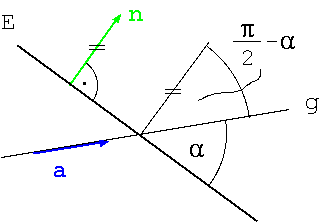
Vektor winkel g e.png


\mathbf{a}\cdot\mathbf{n} = \|\mathbf{a}\|\|\mathbf{n}\| \cos\left( \frac{\pi}{2}-\alpha\right)

Daraus kann man leicht den Winkel α ausrechnen.

Ähnlich funktioniert die Bestimmung eines Winkels zwischen zwei Ebenen. Dort verwendet man eben die Normalenvektoren der beiden Ebenen zur Winkelberechnung.


[Bearbeiten] Übungen

Wikibooks buchseite.svg Zurück zu Permutationen, ... | One wikibook.svg Hoch zu Gesamtinhaltsverzeichnis | Wikibooks buchseite.svg Vor zu Matrizen
Persönliche Werkzeuge