


Linear combinations – Serlo


The main property of vectors is that one can take linear combinations with them. In this chapter you will learn exactly what this is.
Motivation of the term linear combination
[Bearbeiten]Paths on a map
[Bearbeiten]Let's look at the following map:

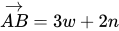
Our goal is to make it from our starting point to the end point . Of course, there are an infinite number of ways to do this. If we want to get from to by the shortest route, we walk along the straight line connecting the two points. Another possibility is to walk three steps westwards from the starting point until we reach the level of the end point and then walk two steps northwards in the direction of .


If is the standard vector towards the west ("vector = marching direction + distance", "standard" means that the distance is 1) and is the standard vector towards the north, then can be represented by the following weighted sum of and :


Decomposing forces
[Bearbeiten]In the following, we will look at an example from physics. Consider the illustration with a ball on an inclined plane. We assume that the ball does not encounter any relevant friction.

The gravitational force acting on our ball is perpendicular to the horizontal (it points down). However, the ball cannot simply fall downwards through the inclined plane. The plane prevents it from doing so. For this reason, we have to decompose the weight force into two parts: one part is perpendicular to the inclined plane and gets countered by the plane itself (normal force ) and one part is parallel to the inclined plane (downward force ). The force accelerates the ball.Both components have to add up to :


![{\displaystyle {\begin{aligned}{\vec {F_{G}}}&={\vec {F_{H}}}+{\vec {F_{N}}}\\[0.3em]&=1\cdot {\vec {F_{H}}}+1\cdot {\vec {F_{N}}}\end{aligned}}}](https://wikimedia.org/api/rest_v1/media/math/render/svg/a1903670f4771124bd1567382cbf57b052c2de6f)
The weight force is thus a simply weighted sum of two components.
Decomposing a vector within a plane
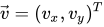
[Bearbeiten]Consider any vector with in the plane. We can then represent each such vector as

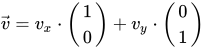
This shows that we can interpret any vector of as a weighted sum of the two standard (normalized) vectors , .


Definition of the linear combination
[Bearbeiten]We have seen that in many examples we can represent vectors as a sum of other vectors with prefactors. We want to generalise our observation and call these sums linear combinations:
Definition (Linear combination)
Let be an -vector space with a field. Each sum with and is called a linear combination. If the vector can be written as , then we say that is a linear combination of the vectors with coefficients .









Examples
[Bearbeiten]Example (Linear combination)
The vector can be written as

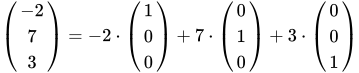
In other words, the vector is a linear combination of the vectors , and with coefficients , and .


Example (Calculation of centre of gravity)
Let us now consider another typical example from physics. The figure shows three particles in with masses , and , which can be described by the respective position vectors , and :


What is their centre of gravity? The total mass is . Then the centre of gravity vector of the system can be determined from the three mass particles by a linear combination:



The vector is a weighted sum of the individual location vectors , , and thus a linear combination of these vectors.
System of equations as linear combination
[Bearbeiten]We consider the following (arbitrarily chosen) system of equations
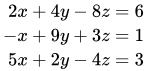
Such a system of equations can be rewritten using vectors and scalars as:
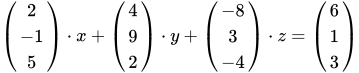
This notation makes it clear that solving a system of equations basically amounts to determining the correct coefficients of a linear combination.

Linear combination as a standard form
[Bearbeiten]We want to show that we can take the linear combination as a kind of standard form for arbitrary combinations of vectors. Any succession of operations such as stretching and addition of vectors can be seen as a linear combination. For this purpose, we consider as examples two arbitrary vectors and as well as the scalars , , and . Let us take the following conjunction of and :



By applying the vector space axioms step by step, we can transform the above conjunction into a linear combination:
![{\displaystyle {\begin{aligned}&{\mathcal {\beta }}(\alpha (v+\mu w)+\lambda v)\\[0.3em]&\quad {\color {OliveGreen}\left\downarrow \ {\text{distributive law for vectors }}\right.}\\[0.3em]=&\beta (\alpha v+\alpha (\mu w))+\lambda v)\\[0.3em]&\quad {\color {OliveGreen}\left\downarrow \ {\text{associative law for scalars }}\right.}\\[0.3em]=&\beta (\alpha v+(\alpha \mu )w)+\lambda v)\\[0.3em]&\quad {\color {OliveGreen}\left\downarrow \ {\text{distributive law for vectors }}\right.}\\[0.3em]=&\beta (\alpha v)+\beta (\alpha \mu )w+\beta (\lambda v)\\[0.3em]&\quad {\color {OliveGreen}\left\downarrow \ {\text{associative law for scalars }}\right.}\\[0.3em]=&(\beta \alpha )v+(\beta \alpha \mu )w+(\beta \lambda )v\\[0.3em]&\quad {\color {OliveGreen}\left\downarrow \ {\text{commutative law }}\right.}\\[0.3em]=&(\beta \alpha )v+(\beta \lambda )v+(\beta \alpha \mu )w\\[0.3em]&\quad {\color {OliveGreen}\left\downarrow \ {\text{distributive law for scalars }}\right.}\\[0.3em]=&(\beta \alpha +\beta \lambda )v+\beta \alpha \mu w\end{aligned}}}](https://wikimedia.org/api/rest_v1/media/math/render/svg/a7623d6ca70b25c29fc8b39fdbd63c648e3b38c2)
At the end of the transformation we get a linear combination of the vectors and . We have noted in each case which vector space axioms were used in the respective steps. With this example, it is easy to see that this procedure can be applied to all combinations of vectors. Thus the linear combination is a kind of standard form for arbitrary links of vectors.


