Lineares Gleichungssystem[Bearbeiten]
Ein Gleichungssystem der Form
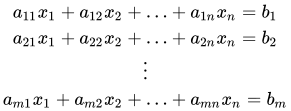
nennt man lineares Gleichungssystem, wobei  die Koeffizienten heißen und
  die Unbekannten sind.
Man kann dies auch als

oder
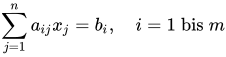
anschreiben.
Gilt  , so nennt man das Gleichungssystem homogen
  , andernfalls inhomogen
  .
.
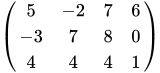
A ist die Koeffizientenmatrix. Als erweiterte Koeffizientenmatrix bezeichnet man die Matrix 
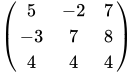
Beispiel:
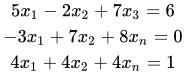
Koeffizientenmatrix:
Erweiterte Koeffizientenmatrix:
Bestimmtheit eines linearen Gleichungssystems[Bearbeiten]
- m>n: überbestimmtes Gleichungssystem
- m=n: quadratisches Gleichungssystem
- m<n: unterbestimmtes Gleichungssystem
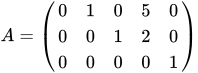
Eine  -Matrix ist in Zeilennormalform, wenn folgende Bedingungen erfüllt sind:
- Unterhalb der Diagonalen dürfen nur Nullen stehen.
- Das erste Zeilenelement ungleich Null ist Eins.
- Ist
 das erste Zeilenelement ungleich Null (d.h eine Eins), so gilt dass der Spaltenvektor dieser Spalte j ein Einheitsvektor ist.
Beispiel für eine Matrix in Zeilennormalform:
Jede Matrix läßt sich durch elementare Zeilenumformungen auf Zeilennormalform bringen.
Elementare Zeilenumformungen sind:
- Zeilenvertauschung
- Multiplikation einer Zeile mit einem Koeffizienten

- Addition des k-fachen einer anderen Zeile.
Der Rang einer Matrix A ist gleich der Anzahl der nicht verschwindenden Zeilen in der Zeilennormalform von A.
Gauß-Jordan-Algorithmus[Bearbeiten]
Wikipedia: Gauß-Jordan-Algorithmus
Nachtrag: Inverse Matrizen[Bearbeiten]
Beispiel: Gegeben sei die Matrix
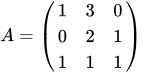 . Gesucht ist die inverse Matrix
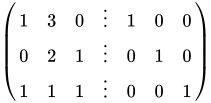

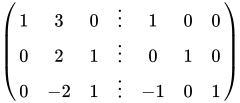

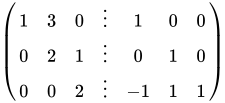

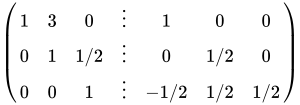
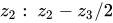
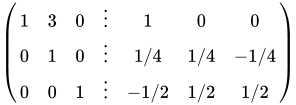



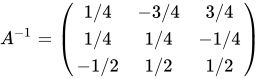
Probe: 
Lösbarkeitskriterien[Bearbeiten]
Ein lineares Gleichungssystem ist
- nicht lösbar, wenn

- lösbar, wenn

Ist das Gleichungssystem lösbar, so besitzt das Gleichungssystem
- genau eine Lösung, wenn
 .
.
- eine (n-k)-parametrige Lösungschar, wenn
 .
.
Daraus folgt auch:
- Nur quadratische oder überbestimmte lineare Gleichungssysteme können eindeutig lösbar sein.
- Lineare homogene Gleichungssysteme sind immer lösbar, da x=o immer eine mögliche Lösung ist.
Wikipedia: Cramersche Regel




