


Exercises: Exponential and Logarithm functions – Serlo


Range of the exponential function
[Bearbeiten]Exercise
Show that
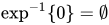
You are supposed to show that holds for all .


How to get to the proof?
We have already shown that holds for all . Let be an arbitrary complex number with , .


Question: How can we express using and ?


Using the exponential functional equation, we get

As , holds if and only if . A good trick to show that a number is not equal to is to show that its absolute value (or the square of its absolute value) is unequal to .


Question: What is ?

Using the computation rules for complex numbers, we get

Hence, we have and the claim follows.
Proof
We have already shown that holds for all . Furthermore, for all , holds that . Hence, for all follows that .

Let be an arbitrary complex number. Then there exist such that . It follows that .




