Bei einer Rechnung muss die Reihenfolge der Rechnungen klar sein, sonst ist das Ergebnis nicht eindeutig:
6
+
3
−
7
+
5
{\displaystyle 6+3-7+5}
:
Wenn man von links nach rechts liest, dann:
6
+
3
=
9
,
9
−
7
=
2
,
2
+
5
=
7
{\displaystyle \ 6+3=9,\ 9-7=2,\ 2+5=7\quad }

also Ergebnis 7.
Wenn man von rechts nach links liest, dann:
12
=
7
+
5
←
,
9
=
3
−
12
←
,
15
=
6
+
9
←
{\displaystyle \ {\overleftarrow {{\color {red}12}=7+5}},\ {\overleftarrow {{\color {lime}9}=3-{\color {red}12}}},\ {\overleftarrow {15=6+{\color {lime}9}}}\quad }
also Ergebnis 15.
Das Ergebnis ist nicht das Gleiche! In den meisten Sprachen der Welt fängt man links an. Dann ist das richtige (und eindeutige) Ergebnis 7. Nur bei Addition oder Multiplikation spielt die Leserichtung und allgemein die Reihenfolge keine Rolle:
6
+
5
+
11
=
5
+
6
+
11
=
11
+
5
+
6
=
5
+
11
+
6
=
22
{\displaystyle 6+5+11=5+6+11=11+5+6=5+11+6=22}
2
⋅
4
⋅
5
=
4
⋅
2
⋅
5
=
2
⋅
5
⋅
4
=
40
{\displaystyle 2\cdot 4\cdot 5=4\cdot 2\cdot 5=2\cdot 5\cdot 4=40}
In diesem Buch wird die Deutsche Leserichtung benutzt, also von links nach rechts.
Was ist, wenn man Strich- und Punktrechnungen gleichzeitig hat? Spielt hier die Reihenfolge wieder keiner Rolle, wie bei der Addition oder der Multiplikation?
2
+
3
⋅
4
{\displaystyle 2+3\cdot 4}
Machen wir die Rechnung einfach von links nach rechts, ist das Ergebnis:
2
+
3
=
5
→
5
⋅
4
=
20
{\displaystyle 2+3=5\ \to \ 5\cdot 4=20}
Ändern wir die Reihenfolge der Multiplikation:
2
+
4
⋅
3
{\displaystyle 2+4\cdot 3}
und machen wir die Rechnung einfach von links nach rechts, bekommen wir ein anderes Ergebnis:
2
+
4
=
6
→
6
⋅
3
=
18
{\displaystyle 2+4=6\ \to \ 6\cdot 3=18}
Es gilt auch:
Wenn man erst die Strichrechnung macht, ist das Ergebnis:
2
+
3
=
5
→
5
⋅
4
=
20
{\displaystyle 2+3=5\ \to \ 5\cdot 4=20}
Wenn man erst die Punktrechnung macht, ist das Ergebnis:
3
⋅
4
=
12
→
2
+
12
=
14
{\displaystyle 3\cdot 4=12\ \to 2+12=14}
Das Ergebnis ist wieder unterschiedlich. Ein unterschiedliches Ergebnis kommt auch dann vor, wenn die Reihenfolge bei der Addition geändert wird und die Multiplikation erst gemacht wird:
2
+
3
⋅
4
{\displaystyle 2+3\cdot 4\ }
und
3
+
2
⋅
4
{\displaystyle \ 3+2\cdot 4}
Hier haben wir die Reihenfolge bei der Addition geändert (einmal steht 2+3 und dann 3+2). Machen wir in beiden Fällen erst die Multiplikation:
2
+
3
⋅
4
=
2
+
12
=
14
{\displaystyle 2+3\cdot 4\ =2+12=14\ }
und
3
+
2
⋅
4
=
3
+
8
=
11
{\displaystyle \ 3+2\cdot 4=3+8=11}
Das Ergebnis ist wieder unterschiedlich. Wenn wir aber einen mathematischen Ausdruck haben, wollen wir ein eindeutiges Ergebnis. Damit das Ergebnis eindeutig ist, muss es eine Regel geben. In der Mathematik haben die Punktrechnungen (mal und durch) immer Vorrang vor den Strichrechnungen (Plus und Minus). Man muss zuerst die Punktrechnungen machen und dann die Strichrechungen. Also ist hier ist 14 das richtige Ergebnis. Wenn es also in einer Rechnung Strich- und Punktrechnungen gibt, dann muss man zuerst die Punktrechnungen machen!
Wenn es aber eine Klammer gibt, dann muss man erst die Rechnung in der Klammer machen:
(
2
+
3
)
⋅
4
=
5
⋅
4
=
20
{\displaystyle (2+3)\cdot 4=5\cdot 4=20\ }
Hier ist das Ergebnis doch
20
{\displaystyle 20}
2
+
(
3
⋅
4
)
=
2
+
12
=
14
{\displaystyle 2+(3\cdot 4)=2+12=14\ }
...und hier ist das Ergebnis wieder
14
{\displaystyle 14}
.
Wenn in einem mathematischen Ausdruck mehrere Rechenarten vorkommen, dann muss eine Regel gelten, damit das Ergebnis eindeutig ist. Die grundlegende Regel lautet:
Klammer vor Punkt vor Strich.
(Zu Erinnerung: Punktrechnungen sind mal und durch, Strichrechnungen sind plus und minus)
Wenn es wiederum innerhalb einer Klammer mehrere Rechnungen gibt, dann muss man die Klammer erst machen und sich in der Klammer an die Regeln halten:
5
+
36
:
(
3
⋅
5
−
6
)
−
(
56
:
7
−
2
)
⋅
3
=
?
{\displaystyle 5+36:(3\cdot 5-6)-(56:7-2)\cdot 3=?}
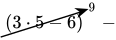
Unterstreichen wir zuerst die Rechnungen in den Klammern:
5
+
{\displaystyle 5+}
36
:
{\displaystyle 36:}
(
3
⋅
5
_
−
6
)
_
−
{\displaystyle {\underline {({\underline {3\cdot 5}}-6)}}\ -}
(
56
:
7
_
−
2
)
_
{\displaystyle {\underline {({\underline {56:7}}-2)}}}
⋅
3
{\displaystyle \cdot 3}
=
{\displaystyle =}
In beiden Klammern muss man zuerst die Punktrechnung machen
15
−
6
{\displaystyle 15-6\quad }
8
−
2
{\displaystyle 8-2}
und dann die Strichrechnung in Klammer
9
{\displaystyle 9}
6
{\displaystyle 6}
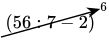
Man kann also die Klammer durch das jeweilige Ergebnis ersetzen
5
+
{\displaystyle 5+}
36
:
{\displaystyle 36:}
(
3
⋅
5
−
6
)
9
−
{\displaystyle {\cancelto {9}{(3\cdot 5-6)}}\ -}
(
56
:
7
−
2
)
6
{\displaystyle {\cancelto {6}{(56:7-2)}}}
⋅
3
=
{\displaystyle \cdot 3=}
5
+
{\displaystyle 5+}
36
:
{\displaystyle 36:}
9
−
{\displaystyle 9-}
6
{\displaystyle 6}
⋅
3
=
{\displaystyle \cdot 3=}
Kompakter geschrieben ist die Rechnung jetzt:
5
+
36
:
9
−
6
⋅
3
{\displaystyle 5+36:9-6\cdot 3\qquad \qquad }
Hier muss man erst die Punktrechnungen machen
5
+
36
:
9
4
−
6
⋅
3
18
=
{\displaystyle 5+{\cancelto {4}{36:9}}-{\cancelto {18}{6\cdot 3}}=}
5
+
4
−
18
=
−
9
{\displaystyle 5+4-18=-9}
Hier das Ganze noch einmal übersichtlicher und in einer Animation:
Animation
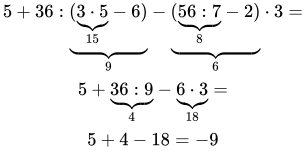
Alle Schritte kompakt dargestellt:
5
+
36
:
(
3
⋅
5
⏟
15
−
6
)
⏟
9
−
(
56
:
7
⏟
8
−
2
)
⏟
6
⋅
3
=
5
+
36
:
9
⏟
4
−
6
⋅
3
⏟
18
=
5
+
4
−
18
=
−
9
{\displaystyle {\begin{array}{c}5+36:\underbrace {(\underbrace {3\cdot 5} _{15}-6)} _{9}-\underbrace {(\underbrace {56:7} _{8}-2)} _{6}\cdot 3=\\5+\underbrace {36:9} _{4}-\underbrace {6\cdot 3} _{18}=\\5+4-18=-9\end{array}}}
11
+
96
:
(
23
−
3
⋅
5
)
−
(
20
−
13
)
+
(
17
−
91
:
7
)
⋅
2
{\displaystyle \ 11+96:(23-3\cdot 5)-(20-13)+(17-91:7)\cdot 2\ }
63
:
(
2
⋅
11
−
30
:
2
)
−
(
90
:
5
−
3
⋅
6
)
⋅
4
{\displaystyle \ 63:(2\cdot 11-30:2)-(90:5-3\cdot 6)\cdot 4}
54
:
(
4
⋅
5
−
14
)
−
34
+
(
105
:
7
−
5
)
⋅
3
−
(
11
+
3
)
{\displaystyle \ 54:(4\cdot 5-14)-34+(105:7-5)\cdot 3-(11+3)\ }
65
:
(
2
⋅
13
−
125
:
5
)
−
(
90
:
6
−
2
⋅
7
)
⋅
65
{\displaystyle \ 65:(2\cdot 13-125:5)-(90:6-2\cdot 7)\cdot 65}
33
−
55
:
(
26
−
3
⋅
5
)
−
(
73
−
14
)
−
(
182
:
13
−
11
)
⋅
10
+
34
{\displaystyle \ 33-55:(26-3\cdot 5)-(73-14)-(182:13-11)\cdot 10+34\ }
66
:
(
2
⋅
11
−
48
:
3
)
−
(
156
:
12
−
3
⋅
4
)
⋅
4
{\displaystyle \ 66:(2\cdot 11-48:3)-(156:12-3\cdot 4)\cdot 4}
99
:
(
32
−
3
⋅
7
)
−
(
65
−
41
)
+
46
+
(
48
:
12
+
5
)
⋅
(
7
−
5
)
{\displaystyle \ 99:(32-3\cdot 7)-(65-41)+46+(48:12+5)\cdot (7-5)\ }
120
:
(
2
⋅
7
−
36
:
9
)
−
(
35
:
5
−
3
⋅
2
)
⋅
4
{\displaystyle \ 120:(2\cdot 7-36:9)-(35:5-3\cdot 2)\cdot 4}
99
:
(
4
⋅
8
−
21
)
+
53
−
(
5
+
54
:
9
)
⋅
3
−
(
14
+
5
)
{\displaystyle \ 99:(4\cdot 8-21)+53-(5+54:9)\cdot 3-(14+5)\ }
(
42
:
3
−
2
⋅
7
)
⋅
5
+
210
:
(
2
⋅
7
−
36
:
9
)
{\displaystyle \ (42:3-2\cdot 7)\cdot 5+210:(2\cdot 7-36:9)}
23
+
56
:
(
23
−
3
⋅
7
)
−
(
7
+
2
)
+
(
3
+
48
:
12
)
⋅
8
{\displaystyle \ 23+56:(23-3\cdot 7)-(7+2)+(3+48:12)\cdot 8\ }
105
:
(
2
⋅
11
−
45
:
3
)
−
(
1
−
9
:
9
)
⋅
5
{\displaystyle \ 105:(2\cdot 11-45:3)-(1-9:9)\cdot 5}
84
:
(
3
⋅
7
−
18
)
−
(
41
−
27
)
+
22
−
(
2
+
60
:
12
)
⋅
9
{\displaystyle \ 84:(3\cdot 7-18)-(41-27)+22-(2+60:12)\cdot 9\ }
13
:
(
2
⋅
12
−
69
:
3
)
−
(
70
:
5
−
2
⋅
7
)
⋅
23
{\displaystyle \ 13:(2\cdot 12-69:3)-(70:5-2\cdot 7)\cdot 23}
33
+
56
:
(
3
⋅
7
−
13
)
−
(
11
+
3
)
−
(
3
+
36
:
18
)
⋅
8
{\displaystyle \ 33+56:(3\cdot 7-13)-(11+3)-(3+36:18)\cdot 8\ }
(
112
:
7
−
4
⋅
4
)
⋅
14
−
17
:
(
2
⋅
11
−
30
:
6
)
{\displaystyle \ (112:7-4\cdot 4)\cdot 14-17:(2\cdot 11-30:6)}
{{:Mathematrix: Vorlage: AufgabeUndAntwort
ANTWORT=
96
:
(
3
⋅
5
−
23
)
+
(
−
13
)
−
(
91
:
7
−
17
)
⋅
2
{\displaystyle \ 96:(3\cdot 5-23)+(-13)-(91:7-17)\cdot 2\ }
Antwort
−
17
{\displaystyle -17}
34
+
54
:
(
4
⋅
5
−
14
)
−
(
105
:
7
−
5
)
⋅
(
−
3
)
{\displaystyle \ 34+54:(4\cdot 5-14)-(105:7-5)\cdot (-3)\ }
Antwort
73
{\displaystyle 73}
55
:
(
3
⋅
5
−
26
)
−
(
−
14
)
−
(
70
:
5
−
17
)
⋅
10
{\displaystyle \ 55:(3\cdot 5-26)-(-14)-(70:5-17)\cdot 10\ }
Antwort
39
{\displaystyle 39}
(
−
41
)
+
99
:
(
3
⋅
7
−
32
)
−
(
8
:
2
+
5
)
⋅
(
−
5
)
{\displaystyle \ (-41)+99:(3\cdot 7-32)-(8:2+5)\cdot (-5)\ }
Antwort
−
5
{\displaystyle -5}
(
−
99
)
:
(
21
−
4
⋅
8
)
+
53
+
(
54
:
9
+
5
)
⋅
(
−
3
)
{\displaystyle \ (-99):(21-4\cdot 8)+53+(54:9+5)\cdot (-3)\ }
Antwort
29
{\displaystyle 29}
23
−
56
:
(
19
−
3
⋅
7
)
−
(
48
:
12
−
11
)
⋅
(
−
8
)
{\displaystyle \ 23-56:(19-3\cdot 7)-(48:12-11)\cdot (-8)\ }
Antwort
−
5
{\displaystyle -5}
84
:
(
3
⋅
7
−
18
)
−
(
−
23
)
+
(
8
:
2
+
3
)
⋅
(
−
9
)
{\displaystyle \ 84:(3\cdot 7-18)-(-23)+(8:2+3)\cdot (-9)\ }
Antwort
−
13
{\displaystyle -13}
33
+
56
:
(
3
⋅
7
−
13
)
−
(
36
:
18
−
7
)
⋅
(
−
8
)
{\displaystyle \ 33+56:(3\cdot 7-13)-(36:18-7)\cdot (-8)\ }
Antwort
0
{\displaystyle 0}
63
:
(
2
⋅
11
−
30
:
2
)
−
(
90
:
5
−
3
⋅
6
)
⋅
4
{\displaystyle \ 63:(2\cdot 11-30:2)-(90:5-3\cdot 6)\cdot 4}
Antwort
9
{\displaystyle 9}
(
−
65
)
:
(
2
⋅
13
−
125
:
5
)
−
(
90
:
6
−
4
⋅
4
)
⋅
65
{\displaystyle \ (-65):(2\cdot 13-125:5)-(90:6-4\cdot 4)\cdot 65}
Antwort
0
{\displaystyle 0}
66
:
(
5
⋅
2
−
48
:
3
)
−
(
156
:
12
−
2
⋅
7
)
⋅
(
−
4
)
{\displaystyle \ 66:(5\cdot 2-48:3)-(156:12-2\cdot 7)\cdot (-4)}
Antwort
−
15
{\displaystyle -15}
(
+
120
)
:
(
2
⋅
7
−
36
:
9
)
−
(
35
:
5
−
3
⋅
2
)
⋅
(
−
4
)
{\displaystyle \ (+120):(2\cdot 7-36:9)-(35:5-3\cdot 2)\cdot (-4)}
Antwort
16
{\displaystyle 16}
(
42
:
3
−
2
⋅
7
)
⋅
(
5
)
+
210
:
(
2
⋅
7
−
36
:
9
)
{\displaystyle \ (42:3-2\cdot 7)\cdot (5)+210:(2\cdot 7-36:9)}
Antwort
21
{\displaystyle 21}
105
:
(
2
⋅
11
−
45
:
3
)
−
(
9
:
9
+
2
⋅
1
)
⋅
5
{\displaystyle \ 105:(2\cdot 11-45:3)-(9:9+2\cdot 1)\cdot 5}
Antwort
0
{\displaystyle 0}
13
:
(
2
⋅
11
−
69
:
3
)
−
(
70
:
5
−
2
⋅
7
)
⋅
23
{\displaystyle \ 13:(2\cdot 11-69:3)-(70:5-2\cdot 7)\cdot 23}
Antwort
−
13
{\displaystyle -13}
(
112
:
7
−
4
⋅
4
)
⋅
14
−
17
:
(
2
⋅
11
−
30
:
6
)
{\displaystyle \ (112:7-4\cdot 4)\cdot 14-17:(2\cdot 11-30:6)}
Antwort
−
1
{\displaystyle -1}
(
4
⋅
11
−
54
:
6
)
:
(
39
:
3
−
2
⋅
9
)
{\displaystyle \ (4\cdot 11-54:6):(39:3-2\cdot 9)}
Antwort
−
7
{\displaystyle -7}
(
4
⋅
3
−
84
:
7
)
:
(
78
:
3
−
4
⋅
7
)
{\displaystyle \ (4\cdot 3-84:7):(78:3-4\cdot 7)}
Antwort
0
{\displaystyle 0}
(
54
:
6
−
8
⋅
3
)
:
(
64
:
4
−
3
⋅
7
)
{\displaystyle \ (54:6-8\cdot 3):(64:4-3\cdot 7)}
Antwort
3
{\displaystyle 3}
(
7
⋅
3
−
56
:
2
)
:
(
45
:
3
−
4
⋅
2
)
{\displaystyle \ (7\cdot 3-56:2):(45:3-4\cdot 2)}
Antwort
−
1
{\displaystyle -1}
(
4
⋅
7
−
26
:
2
)
:
(
45
:
3
−
4
⋅
3
)
{\displaystyle \ (4\cdot 7-26:2):(45:3-4\cdot 3)}
Antwort
3
{\displaystyle 3}
(
5
⋅
3
+
39
:
3
)
:
(
24
:
3
+
4
⋅
5
)
{\displaystyle \ (5\cdot 3+39:3):(24:3+4\cdot 5)}
Antwort
1
{\displaystyle 1}
(
8
:
2
−
54
:
6
)
:
(
39
:
3
−
2
⋅
9
)
{\displaystyle \ (8:2-54:6):(39:3-2\cdot 9)}
Antwort
1
{\displaystyle 1}
(
5
⋅
2
−
54
:
6
)
:
(
45
:
9
−
2
⋅
2
)
{\displaystyle \ (5\cdot 2-54:6):(45:9-2\cdot 2)}
Antwort
1
{\displaystyle 1}
An der Tafel steht folgende Rechnung. Leider gibt es einen Fehler. Wo liegt er?
21
+
56
:
7
−
(
79
−
2
⋅
5
)
:
3
=
{\displaystyle 21+56:7-(79-2\cdot 5):3=}
77
:
7
−
(
79
−
10
)
:
3
=
{\displaystyle 77:7-(79-10):3=}
11
−
69
:
3
=
11
−
23
=
{\displaystyle 11-69:3=11-23=}
−
12
{\displaystyle -12}
Berechnen Sie jetzt richtig:
21
+
56
:
7
−
(
79
−
2
⋅
5
)
:
3...
{\displaystyle 21+56:7-(79-2\cdot 5):3...}
An der Tafel steht folgende Rechnung. Leider gibt es einen Fehler. Wo liegt er?
43
+
56
:
8
−
(
30
−
2
⋅
5
)
:
4
=
{\displaystyle 43+56:8-(30-2\cdot 5):4=}
43
+
7
−
(
28
⋅
5
)
:
4
=
{\displaystyle 43+7-(28\cdot 5):4=}
50
−
140
:
4
=
{\displaystyle 50-140:4=}
50
−
35
=
{\displaystyle 50-35=}
15
{\displaystyle 15}
Berechnen Sie jetzt richtig:
43
+
56
:
8
−
(
30
−
2
⋅
5
)
:
4
=
.
.
.
{\displaystyle 43+56:8-(30-2\cdot 5):4=...}
An der Tafel steht folgende Rechnung. Leider gibt es einen Fehler. Wo liegt er?
43
+
72
:
8
−
(
56
−
2
⋅
20
)
:
4
=
{\displaystyle 43+72:8-(56-2\cdot 20):4=}
43
+
9
−
(
56
−
2
⋅
5
)
=
{\displaystyle 43+9-(56-2\cdot 5)=}
52
−
(
56
−
10
)
=
{\displaystyle 52-(56-10)=}
52
−
46
=
{\displaystyle 52-46=}
6
{\displaystyle 6}
Berechnen Sie jetzt richtig:
43
+
72
:
8
−
(
56
−
2
⋅
20
)
:
4
=
.
.
.
{\displaystyle 43+72:8-(56-2\cdot 20):4=...}
An der Tafel steht folgende Rechnung. Leider gibt es einen Fehler. Wo liegt er?
63
−
(
56
:
7
−
2
)
⋅
9
+
72
:
3
=
{\displaystyle 63-(56:7-2)\cdot 9+72:3=}
63
−
(
8
−
2
)
⋅
81
:
3
=
{\displaystyle 63-(8-2)\cdot 81:3=}
63
−
6
⋅
81
:
3
=
{\displaystyle 63-6\cdot 81:3=}
63
−
486
:
3
=
{\displaystyle 63-486:3=}
−
99
{\displaystyle -99}
Berechnen Sie jetzt richtig:
63
−
(
56
:
7
−
2
)
⋅
9
+
72
:
3
=
{\displaystyle 63-(56:7-2)\cdot 9+72:3=}
An der Tafel steht folgende Rechnung. Leider gibt es einen Fehler. Wo liegt er?
21
+
56
:
7
−
(
77
−
2
⋅
4
)
:
3
=
{\displaystyle 21+56:7-(77-2\cdot 4):3=}
21
+
8
−
(
75
⋅
4
)
:
3
=
{\displaystyle 21+8-(75\cdot 4):3=}
29
−
300
:
3
=
29
−
100
=
{\displaystyle 29-300:3=29-100=}
−
71
{\displaystyle -71}
Berechnen Sie jetzt richtig:
21
+
56
:
7
−
(
77
−
2
⋅
4
)
:
3
=
.
.
.
{\displaystyle 21+56:7-(77-2\cdot 4):3=...}
An der Tafel steht folgende Rechnung. Leider gibt es einen Fehler. Wo liegt er?
40
+
56
:
8
−
(
30
−
2
⋅
5
)
:
4
=
{\displaystyle 40+56:8-(30-2\cdot 5):4=}
96
:
8
−
(
30
−
10
)
:
4
=
{\displaystyle 96:8-(30-10):4=}
12
−
20
:
4
=
{\displaystyle 12-20:4=}
12
−
5
=
{\displaystyle 12-5=}
7
{\displaystyle 7}
Berechnen Sie jetzt richtig:
43
+
56
:
8
−
(
30
−
2
⋅
5
)
:
4
=
.
.
.
{\displaystyle 43+56:8-(30-2\cdot 5):4=...}
An der Tafel steht folgende Rechnung. Leider gibt es einen Fehler. Wo liegt er?
33
+
72
:
8
−
(
56
−
2
⋅
20
)
:
4
=
{\displaystyle 33+72:8-(56-2\cdot 20):4=}
33
+
9
−
(
56
−
40
)
:
4
=
{\displaystyle 33+9-(56-40):4=}
42
−
(
56
−
10
)
=
{\displaystyle 42-(56-10)=}
42
−
46
=
{\displaystyle 42-46=}
−
4
{\displaystyle -4}
Berechnen Sie jetzt richtig:
33
+
72
:
8
−
(
56
−
2
⋅
20
)
:
4
=
.
.
.
{\displaystyle 33+72:8-(56-2\cdot 20):4=...}
An der Tafel steht folgende Rechnung. Leider gibt es einen Fehler. Wo liegt er?
63
−
(
56
:
7
−
2
)
:
3
+
72
:
6
=
{\displaystyle 63-(56:7-2):3+72:6=}
63
−
(
8
−
2
)
:
3
+
72
:
6
=
{\displaystyle 63-(8-2):3+72:6=}
63
−
6
:
3
+
72
:
6
=
{\displaystyle 63-6:3+72:6=}
57
:
3
−
12
=
{\displaystyle 57:3-12=}
7
{\displaystyle 7}
Berechnen Sie jetzt richtig:
63
−
(
56
:
7
−
2
)
⋅
9
+
72
:
3
=
{\displaystyle 63-(56:7-2)\cdot 9+72:3=}